Application
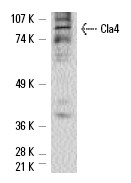
Western blot analysis of Cla4 expression in S. cerevisiae whole cell lysate.| Product Name | Cla4 Antibody (y-371) |
|---|---|
| Antibody Type | Primary Antibodies |
| Antigen Alias | epitope corresponding to amino acids 140-511 of Cla4 of Saccharomyces cerevisiae origin |
| Modification Notes | Extracellular pheromones bind to cell surface receptors and stimulate the activation of the kinase Ste20. This leads to the activation of the MAPKKK Ste11 and the subsequent members of this MAP kinase cascade, Ste7, Fus3 (also called Dac2) and Kss1 (1). These MAP kinases activate Ste12 and Far1, which effect transcriptional and morphological changes necessary for mating (2,3). Cdc42, a small GTP-binding protein, is thought to activate Ste20. Cdc42 also plays a role in the polarization of budding (4). Cla4, a homolog of Ste20, interacts with Cdc42 and is also involved in budding and cytokinesis (5,6). Cdc11 is also required for cytokinesis and is present at the bud neck during cell division (7). The kinase Elm1 regulates morphologic differentiation and is involved in controlling pseudohyphal growth (8,9). |
| Clonality | Polyclonal |
|---|---|
| Isotype | IgG |
| Host Species | Rabbit |
| Tested Applications | WBIPELISA |
| recommended for detection of Cla4 of Saccharomyces cerevisiae origin of WB, IP and ELISA: |
|
| Species Reactivity | HumanMouseRat |
| Concentration | 1mg/ml |
| Purification | Affinity purified |
| Alternative Names | epitope corresponding to amino acids 140-511 of Cla4 of Saccharomyces cerevisiae origin |
|---|---|
| Tissue Specificity | epitope corresponding to amino acids 140-511 of Cla4 of Saccharomyces cerevisiae origin |
Application
Western blot analysis of Cla4 expression in S. cerevisiae whole cell lysate.| Application Notes | recommended for detection of Cla4 of Saccharomyces cerevisiae origin of WB, IP and ELISA: |
|---|
| Form | Liquid |
|---|---|
| Storage Instructions | For short-term storage, store at 4° C. For long-term storage, aliquot and store at -20ºC or below. Avoid multiple freeze-thaw cycles. |
| Storage Buffer | phosphate buffered saline , pH 7.4, 150mM NaCl, 0.02% sodium azide and 50% glycerol. |


