Application
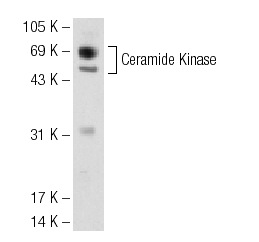
Western blot analysis of Ceramide Kinase expression in mouse heart tissue extract.| Product Name | Ceramide Kinase Antibody (H-237) |
|---|---|
| Antibody Type | Primary Antibodies |
| Antigen Alias | epitope corresponding to amino acids 238-474 mapping near the C-terminus of Ceramide Kinase of human origin |
| Modification Notes | Ceramide Kinase, also known as CERK, LK4 (lipid kinase 4) or acylsphingosine kinase, is a 537 amino acid peripheral membrane protein that localizes to both the membrane and the cytoplasm and contains one DAGHc domain. Highly expressed in brain, liver, kidney, heart and skeletal muscle, with lower expression in spleen, lung, thymus and small intestine, Ceramide Kinase uses calcium and magnesium as cofactors to catalyze the ATP-dependent conversion of Ceramide to Ceramide 1-phosphate (C1P), a sphingolipid metabolite. Ceramide Kinase functions at an optimal pH of 6-7.5 and, via its catalytic activity, plays an important role in a variety of cellular processes, including apoptosis, phagocytosis and cellular proliferation. |
| Clonality | Polyclonal |
|---|---|
| Isotype | IgG |
| Host Species | Rabbit |
| Tested Applications | WBIPIFELISA |
| recommended for detection of Ceramide Kinase of mouse, rat and human origin by WB, IP, IF and ELISA also reactive with additional species, including equine and canine: |
|
| Species Reactivity | HumanMouseRat |
| Concentration | 1mg/ml |
| Purification | Affinity purified |
| Alternative Names | epitope corresponding to amino acids 238-474 mapping near the C-terminus of Ceramide Kinase of human origin |
|---|---|
| Tissue Specificity | epitope corresponding to amino acids 238-474 mapping near the C-terminus of Ceramide Kinase of human origin |
| Entrez Gene | 64781 |
|---|
Application
Western blot analysis of Ceramide Kinase expression in mouse heart tissue extract.| Application Notes | recommended for detection of Ceramide Kinase of mouse, rat and human origin by WB, IP, IF and ELISA also reactive with additional species, including equine and canine: |
|---|
| Form | Liquid |
|---|---|
| Storage Instructions | For short-term storage, store at 4° C. For long-term storage, aliquot and store at -20ºC or below. Avoid multiple freeze-thaw cycles. |
| Storage Buffer | phosphate buffered saline , pH 7.4, 150mM NaCl, 0.02% sodium azide and 50% glycerol. |


