Application
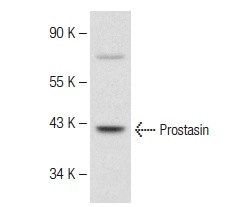
Western blot analysis of Prostasin expression in Hep G2 whole cell lysate.| Product Name | Prostasin Antibody (M-52) |
|---|---|
| Antibody Type | Primary Antibodies |
| Antigen Alias | epitope corresponding to amino acids 171-222 mapping within an internal region of Prostasin of mouse origin |
| Modification Notes | Prostasin, a serine protease first identified in prostate tissue, activates epithelial sodium channels in a variety of tissues. Though typically a membrane-anchored protein, free prostasin is also found in physiologic fluids and tissue culture media, indicating a mechanism for secretion from the cells as well. Aprotinin and other protease inhibitors suppress the channel-activating capacity of prostasin, while aldosterone increases prostasin expression and stimulates sodium uptake. In addition, DNA methylation negatively correlates with prostasin expression in cancer cells, while enforced reexpression decreases invasiveness as well as metastatic potential, implying that prostasin activity reflects epithelial cell physiology. |
| Clonality | Polyclonal |
|---|---|
| Isotype | IgG |
| Host Species | Rabbit |
| Tested Applications | WBIPIFELISA |
| recommended for detection of Prostasin of mouse, rat and, to a lesser extent, human origin by WB, IP, IF and ELISA also reactive with additional species, including canine, bovine and porcine: |
|
| Species Reactivity | HumanMouseRat |
| Concentration | 1mg/ml |
| Purification | Affinity purified |
| Alternative Names | epitope corresponding to amino acids 171-222 mapping within an internal region of Prostasin of mouse origin |
|---|---|
| Tissue Specificity | epitope corresponding to amino acids 171-222 mapping within an internal region of Prostasin of mouse origin |
Application
Western blot analysis of Prostasin expression in Hep G2 whole cell lysate.| Application Notes | recommended for detection of Prostasin of mouse, rat and, to a lesser extent, human origin by WB, IP, IF and ELISA also reactive with additional species, including canine, bovine and porcine: |
|---|
| Form | Liquid |
|---|---|
| Storage Instructions | For short-term storage, store at 4° C. For long-term storage, aliquot and store at -20ºC or below. Avoid multiple freeze-thaw cycles. |
| Storage Buffer | phosphate buffered saline , pH 7.4, 150mM NaCl, 0.02% sodium azide and 50% glycerol. |


