Application
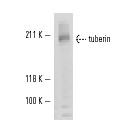
Western blot analysis of tuberin expression in PDGF-treated 3611-RF whole cell lysate.Application
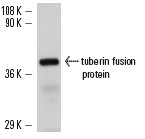
Western blot analysis of human recombinant tuberin fusion protein.| Product Name | tuberin Antibody (H-300) |
|---|---|
| Antibody Type | Primary Antibodies |
| Antigen Alias | epitope corresponding to amino acids 1-300 mapping at the N-terminus of tuberin of human origin |
| Modification Notes | Tuberous sclerosis complex (TSC) is an autosomal dominant genetic disorder characterized by mental retardation and the widespread development of distinctive tumors termed hamartomas. Two different genetic loci have been linked to TSC; one of these loci, the tuberous sclerosis-2 gene (TSC2), encodes a protein called tuberin and the other loci, tuberous sclerosis-1 gene (TSC1), encodes a protein called hamartin. Tuberin and hamartin interact with each other forming a cystoplasmic complex. Hamartin interacts with the ezrin-radixin-moesin (ERM) family of actin-binding proteins and inhibition of hamartin activity results in loss of cell adhesion. Hamartin is present in most adult tissues with strong expression in brain, heart, and kidney. |
| Clonality | Polyclonal |
|---|---|
| Isotype | IgG |
| Host Species | Rabbit |
| Tested Applications | WBIPIFELISA |
| recommended for detection of tuberin of mouse, rat and human origin by WB, IP, IF and ELISA also reactive with additional species, including equine, canine, porcine and avian: |
|
| Species Reactivity | HumanMouseRat |
| Concentration | 1mg/ml |
| Purification | Affinity purified |
| Alternative Names | epitope corresponding to amino acids 1-300 mapping at the N-terminus of tuberin of human origin |
|---|---|
| Tissue Specificity | epitope corresponding to amino acids 1-300 mapping at the N-terminus of tuberin of human origin |
| Entrez Gene | 7249 |
|---|
Application
Western blot analysis of tuberin expression in PDGF-treated 3611-RF whole cell lysate.
Application
Western blot analysis of human recombinant tuberin fusion protein.| Application Notes | recommended for detection of tuberin of mouse, rat and human origin by WB, IP, IF and ELISA also reactive with additional species, including equine, canine, porcine and avian: |
|---|
| Form | Liquid |
|---|---|
| Storage Instructions | For short-term storage, store at 4° C. For long-term storage, aliquot and store at -20ºC or below. Avoid multiple freeze-thaw cycles. |
| Storage Buffer | phosphate buffered saline , pH 7.4, 150mM NaCl, 0.02% sodium azide and 50% glycerol. |


