Application
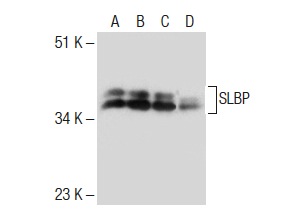
Western blot analysis of SLBP expression in Jurkat (A), HeLa (B) and Hep G2 (C) nuclear extracts and mouse lympth node tissue extract (D).| Product Name | SLBP Antibody (H-160) |
|---|---|
| Antibody Type | Primary Antibodies |
| Antigen Alias | epitope corresponding to amino acids 56-215 mapping within an internal region of SLBP of human origin |
| Modification Notes | Replication-dependent histone mRNAs lack polyadenylated tails and instead end in a conserved stem-loop. The stem-loop binding protein (SLBP) binds the 3' end of histone mRNA and contains a 73 amino acid RNA-binding domain. SLBP mediates the interaction of the histone pre-mRNA with U7 SnRNP to facilitate 3' end processing. SLBP is required for the translation of stem-loop mRNAs. SLBP forms a stable complex with U7 SnRNP in the nucleus as well as the cytoplasm. hZFP100 is a zinc finger protein that interacts with the SLBP/RNA complex but not with free SLBP. During the cell cycle, SLBP increases in the late G1 and decreases in the S/G2 border. The regulation of SLBP occurs at the level of translation. Specifically, two phosphorylation events on threonine 99 and threonine 104 trigger the degradation of SLBP in late S phase cells. |
| Clonality | Polyclonal |
|---|---|
| Isotype | IgG |
| Host Species | Rabbit |
| Tested Applications | WBIPIFELISA |
| recommended for detection of SLBP of mouse, rat and human origin by WB, IP, IF and ELISA also reactive with additional species, including equine, canine, bovine and porcine: |
|
| Species Reactivity | HumanMouseRat |
| Concentration | 1mg/ml |
| Purification | Affinity purified |
| Alternative Names | epitope corresponding to amino acids 56-215 mapping within an internal region of SLBP of human origin |
|---|---|
| Tissue Specificity | epitope corresponding to amino acids 56-215 mapping within an internal region of SLBP of human origin |
| Entrez Gene | 7884 |
|---|
Application
Western blot analysis of SLBP expression in Jurkat (A), HeLa (B) and Hep G2 (C) nuclear extracts and mouse lympth node tissue extract (D).| Application Notes | recommended for detection of SLBP of mouse, rat and human origin by WB, IP, IF and ELISA also reactive with additional species, including equine, canine, bovine and porcine: |
|---|
| Form | Liquid |
|---|---|
| Storage Instructions | For short-term storage, store at 4° C. For long-term storage, aliquot and store at -20ºC or below. Avoid multiple freeze-thaw cycles. |
| Storage Buffer | phosphate buffered saline , pH 7.4, 150mM NaCl, 0.02% sodium azide and 50% glycerol. |


