Application
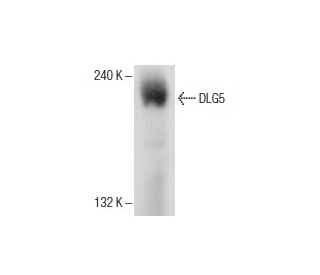
Western blot analysis of DLG5 expression in human placenta tissue extract.| Product Name | DLG5 Antibody (H-300) |
|---|---|
| Antibody Type | Primary Antibodies |
| Antigen Alias | epitope corresponding to amino acids 355-654 mapping within an internal region of DLG5 of human origin |
| Modification Notes | Membrane-associated guanylate kinase (MAGUK) family members function as molecular scaffolds for the assembly of multiprotein complexes localizing to the plasma membrane. Several mammalian proteins related to the Drosophila tumor suppressor discs-large (dlg) gene product belong to the MAGUK family. MAGUK family members include the postsynaptic proteins PSD-93, DLG5, Pals1, PSD-95 (SAP 90), densin-180, NE-dlg (SAP 120), dlg-1 (SAP 97), GKAP (GK-associated protein), p55, the tight junction associated proteins ZO-1-3 and the caspase-associated recruitment domain (CARD) proteins CARD6, CARD8-12 and CARD14. DLG5, a cell-cell junction peripheral membrane protein, plays an important role in maintaining the structure of epithelial cell plasma membranes. It also plays an important part in transmitting extracellular signals to the cytoskeleton and the membrane. DLG5 which can interact with MPP1 and CTNNB1, is primarily expressed in prostate and placenta. |
| Clonality | Polyclonal |
|---|---|
| Isotype | IgG |
| Host Species | Rabbit |
| Tested Applications | WBIPIFELISA |
| recommended for detection of DLG5 isoforms 1, 2 and 4 and, to a lesser extent, isoform 3 of mouse, rat and human origin by WB, IP, IF and ELISA: WB:1:100~1:200 IP:1:20~1:100 IF:1:20~1:100 |
|
| Species Reactivity | HumanMouseRat |
| Predicted Reactivity | equine, canine and bovine |
| Concentration | 1mg/ml |
| Purification | Affinity purified |
| Alternative Names | epitope corresponding to amino acids 355-654 mapping within an internal region of DLG5 of human origin |
|---|---|
| Molecular Weight(MW) | 214 kDa |
| Tissue Specificity | epitope corresponding to amino acids 355-654 mapping within an internal region of DLG5 of human origin |
Application
Western blot analysis of DLG5 expression in human placenta tissue extract.| Application Notes | recommended for detection of DLG5 isoforms 1, 2 and 4 and, to a lesser extent, isoform 3 of mouse, rat and human origin by WB, IP, IF and ELISA: WB:1:100~1:200 IP:1:20~1:100 IF:1:20~1:100 |
|---|
| Form | Liquid |
|---|---|
| Storage Instructions | For short-term storage, store at 4° C. For long-term storage, aliquot and store at -20ºC or below. Avoid multiple freeze-thaw cycles. |
| Storage Buffer | phosphate buffered saline , pH 7.4, 150mM NaCl, 0.02% sodium azide and 50% glycerol. |


