Application
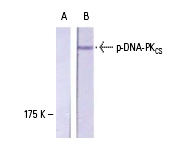
Western blot analysis of phosphorylated DNA-PKCS expression in untreated (A) and hydroxyurea-treated (B) K-562 whole cell lysates.| Product Name | p-DNA-PKCS Antibody (Thr 2609) |
|---|---|
| Antibody Type | Primary Antibodies |
| Antigen Alias | epitope corresponding to phosphorylated Thr 2609 of DNA-PKCS of human origin |
| Modification | Phosphoralated |
| Modification Notes | The phosphatidylinositol kinase (PIK) family members fall into two distinct subgroups. The first subgroup contains proteins such as the PI 3- and PI 4-kinases and the second group comprises the PIK-related kinases. The PIK-related kinases include Atm, DNA-PKCS and FRAP. These proteins have in common a region of homology at their carboxy termini that is not present in the PI 3- and PI 4-kinases. The Atm gene is mutated in the autosomal recessive disorder ataxia telangiectasia (AT) that is characterized by cerebellar degeneration (ataxia) and the appearance of dilated blood vessels (telangiectases) in the conjunctivae of the eyes. AT cells are hypersensitive to ionizing radiation, impaired in mediating the inhibition of DNA synthesis and they display delays in p53 induction. DNA-PK is a heterotrimeric DNA binding enzyme that is composed of a large subunit, DNA-PKCS, and two smaller subunits collectively known as Ku. The loss of DNA-PK leads to defects in DSB repair and V(D)J recombination. FRAP can autophosphorylate on serine and bind to rapamycin/FKBP. FRAP is also an upstream regulator of S6 kinase and has been implicated in the regulation of p27 and p21 expression. |
| Clonality | Polyclonal |
|---|---|
| Isotype | IgG |
| Host Species | Rabbit |
| Tested Applications | WBIP |
| recommended for detection of Thr 2609 phosphorylated DNA-PKCS of h origin by WB and IP: |
|
| Species Reactivity | HumanMouseRat |
| Concentration | 1mg/ml |
| Purification | Affinity purified |
| Alternative Names | epitope corresponding to phosphorylated Thr 2609 of DNA-PKCS of human origin |
|---|---|
| Tissue Specificity | epitope corresponding to phosphorylated Thr 2609 of DNA-PKCS of human origin |
| Entrez Gene | 5591 |
|---|
Application
Western blot analysis of phosphorylated DNA-PKCS expression in untreated (A) and hydroxyurea-treated (B) K-562 whole cell lysates.| Application Notes | recommended for detection of Thr 2609 phosphorylated DNA-PKCS of h origin by WB and IP: |
|---|
| Form | Liquid |
|---|---|
| Storage Instructions | For short-term storage, store at 4° C. For long-term storage, aliquot and store at -20ºC or below. Avoid multiple freeze-thaw cycles. |
| Storage Buffer | phosphate buffered saline , pH 7.4, 150mM NaCl, 0.02% sodium azide and 50% glycerol. |


