Application
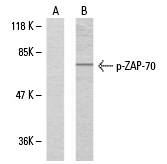
Antibodies tested include p-ZAP-70 (Tyr 319): preincubated with cognate phosphorylated peptide (A) and p-ZAP-70 (Tyr 319): (B).| Product Name | p-ZAP-70 Antibody (Tyr 319) |
|---|---|
| Antibody Type | Primary Antibodies |
| Antigen Alias | raised against a short amino acid sequence containing phosphorylated Tyr 493 of ZAP-70 of human origin |
| Modification | Phosphoralated |
| Modification Notes | The activation of T lymphocytes by antigens is mediated by the T cell receptor (TCR), which is a multisubunit complex assembled from at least six different genes (1,2). The TCR subunits include the Ti a and b chains, the CD3 g , d and e chains and a z -containing homodimer or heterodimer (1,2). The protein tyrosine kinase ZAP-70 binds to the phosphorylated immunoreceptor tyrosine-base activation motifs (ITAMs) of the TCR z chain through two src-homology (SH2) domains (3,4). This binding results in the phosphorylation of ZAP-70 on multiple tyrosine residues, including Tyr292 and Tyr319 (4). ZAP-70 is autophosphorylated on Tyr292, which is thought to negatively regulate ZAP-70 function in lymphocytes (5,6). Alternatively, ZAP-70 is positively regulated by phosphorylation on Tyr319, which mediates the SH2-dependent interaction between Lck and ZAP-70 (5,6). |
| Clonality | Polyclonal |
|---|---|
| Isotype | IgG |
| Host Species | Rabbit |
| Tested Applications | WBIP |
| recommended for detection of Tyr 319 phosphorylated ZAP-70 of human origin and correspondingly phosphorylated Tyr 318 of mouse origin and correspondingly phosphorylated Tyr 314 rat origin by WB and IP also recommended for detection of Tyr 352 phosphorylated Syk of human origin and correspondingly phosphorylated Tyr 346 of mouse and rat origin: |
|
| Species Reactivity | HumanMouseRat |
| Concentration | 1mg/ml |
| Purification | Affinity purified |
| Alternative Names | raised against a short amino acid sequence containing phosphorylated Tyr 493 of ZAP-70 of human origin |
|---|---|
| Tissue Specificity | raised against a short amino acid sequence containing phosphorylated Tyr 493 of ZAP-70 of human origin |
| Entrez Gene | 7535 |
|---|
Application
Antibodies tested include p-ZAP-70 (Tyr 319): preincubated with cognate phosphorylated peptide (A) and p-ZAP-70 (Tyr 319): (B).| Application Notes | recommended for detection of Tyr 319 phosphorylated ZAP-70 of human origin and correspondingly phosphorylated Tyr 318 of mouse origin and correspondingly phosphorylated Tyr 314 rat origin by WB and IP also recommended for detection of Tyr 352 phosphorylated Syk of human origin and correspondingly phosphorylated Tyr 346 of mouse and rat origin: |
|---|
| Form | Liquid |
|---|---|
| Storage Instructions | For short-term storage, store at 4° C. For long-term storage, aliquot and store at -20ºC or below. Avoid multiple freeze-thaw cycles. |
| Storage Buffer | phosphate buffered saline , pH 7.4, 150mM NaCl, 0.02% sodium azide and 50% glycerol. |


