Application
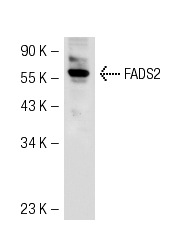
Western blot analysis of FADS2 expression in Ramos whole cell lysate.| Product Name | FADS2 Antibody (H-40) |
|---|---|
| Antibody Type | Primary Antibodies |
| Antigen Alias | epitope corresponding to amino acids 136-175 mapping within an internal region of FADS2 of human origin |
| Modification Notes | Members of the fatty acid desaturase (FADS) family, including FADS1, FADS2 and FADS3, regulate the desaturation of fatty acids by introducing double bonds between defined carbons of fatty acyl chains, thereby playing an essential role in the lipid metabolic pathway. Members of this family share N-terminal cytochrome b5-like domains, C-terminal multiple membrane-spanning desaturase regions and 3 histidine box motifs. FADS2 (fatty acid desaturase 2), also known as D6D, DES6, LLCDL2 or TU13, is a 444 amino acid multi-pass membrane protein that localizes to the endoplasmic reticulum and contains one cytochrome b5 heme-binding domain. Expressed in adult and fetal heart and in adult liver, brain, lung and retina, FADS2 functions as a component of a lipid metabolic pathway and catalyzes the first step in the pathway, namely the formation of unsaturated fatty acids from polyunsaturated fatty acids. Defects in the gene encoding FADS2 are the cause of cause of fatty acid delta-6-desaturase deficiency, an affliction that is characterized by skin abnormalities, corneal ulceration and growth failure. Multiple isoforms of FADS2 exist due to alternative splicing events. |
| Clonality | Polyclonal |
|---|---|
| Isotype | IgG |
| Host Species | Rabbit |
| Tested Applications | WBIPIFELISA |
| recommended for detection of FADS2 of human and, to a lesser extent, mouse and rat origin by WB, IP, IF and ELISA also reactive with additional species, including bovine: |
|
| Species Reactivity | HumanMouseRat |
| Concentration | 1mg/ml |
| Purification | Affinity purified |
| Alternative Names | epitope corresponding to amino acids 136-175 mapping within an internal region of FADS2 of human origin |
|---|---|
| Tissue Specificity | epitope corresponding to amino acids 136-175 mapping within an internal region of FADS2 of human origin |
| Entrez Gene | 9415 |
|---|
Application
Western blot analysis of FADS2 expression in Ramos whole cell lysate.| Application Notes | recommended for detection of FADS2 of human and, to a lesser extent, mouse and rat origin by WB, IP, IF and ELISA also reactive with additional species, including bovine: |
|---|
| Form | Liquid |
|---|---|
| Storage Instructions | For short-term storage, store at 4° C. For long-term storage, aliquot and store at -20ºC or below. Avoid multiple freeze-thaw cycles. |
| Storage Buffer | phosphate buffered saline , pH 7.4, 150mM NaCl, 0.02% sodium azide and 50% glycerol. |


