Application
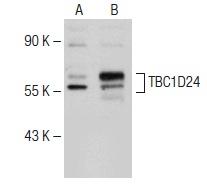
Western blot analysis of TBC1D24 expression in non-transfected: (A) and human TBC1D24 transfected: (B) 293T whole cell lysates.| Product Name | TBC1D24 Antibody (P-14) |
|---|---|
| Antibody Type | Primary Antibodies |
| Antigen Alias | epitope mapping within an internal region of TBC1D24 of human origin |
| Modification Notes | TBC1D24 (TBC1 domain family member 24) is a 559 amino acid cytoplasmic protein that may act as a GTPase-activating protein for Rab family proteins and exists as two alternatively spliced isoforms. TBC1D24 contains one Rab-GAP TBC domain, one TLD domain and interacts with ARF6. Involved in neuronal projection development, probably through a negative modulation of ARF6 function, TBC1D24 is highly expressed in brain. TBC1D24 is also expressed in testis, skeletal muscle, heart, kidney, lung and liver. Defects in the TBC1D24 gene are the cause of familial infantile myoclonic epilepsy (FIME), which is characterized as a subtype of idiopathic epilepsy starting in early infancy and manifesting as myoclonic seizures, febrile convulsions and tonic-clonic seizures. The gene that encodes TBC1D24 contains 28,353 bases and maps to human chromosome 16p13.3. |
| Clonality | Polyclonal |
|---|---|
| Isotype | IgG |
| Host Species | Rabbit |
| Tested Applications | WBIPIFELISA |
| recommended for detection of TBC1D24 of mouse, rat and human origin by WB, IP, IF and ELISA non cross-reactive with other TBC1D family members also reactive with additional species, including equine, canine, bovine and avian: |
|
| Species Reactivity | HumanMouseRat |
| Concentration | 1mg/ml |
| Purification | Affinity purified |
| Alternative Names | epitope mapping within an internal region of TBC1D24 of human origin |
|---|---|
| Tissue Specificity | epitope mapping within an internal region of TBC1D24 of human origin |
| Entrez Gene | 57465 |
|---|
Application
Western blot analysis of TBC1D24 expression in non-transfected: (A) and human TBC1D24 transfected: (B) 293T whole cell lysates.| Application Notes | recommended for detection of TBC1D24 of mouse, rat and human origin by WB, IP, IF and ELISA non cross-reactive with other TBC1D family members also reactive with additional species, including equine, canine, bovine and avian: |
|---|
| Form | Liquid |
|---|---|
| Storage Instructions | For short-term storage, store at 4° C. For long-term storage, aliquot and store at -20ºC or below. Avoid multiple freeze-thaw cycles. |
| Storage Buffer | phosphate buffered saline , pH 7.4, 150mM NaCl, 0.02% sodium azide and 50% glycerol. |


