Application
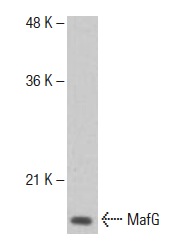
Western blot analysis of MafG expression in Hep G2 whole cell lysate.Application
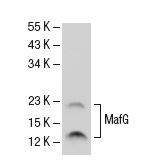
Western blot analysis of MafG expression in NIH/3T3 whole cell lysate.| Product Name | MafG Antibody (Y-25) |
|---|---|
| Antibody Type | Primary Antibodies |
| Antigen Alias | recommended for detection of MafG of mouse, rat and human origin by WB, IP and ELISA; also reactive with additional species, including canine |
| Modification Notes | Members of the Maf family of basic region/leucine zipper (bZIP) transcription factors affect transcription in either a positive or negative fashion, depending on their particular protein partner and the context of the target promoter (1). c-Maf (Maf-2) and the closely related family members Neural retina leucine zipper (Nrl), L-Maf, and Krml1/MafB (Maf-1) all bind to T-MARE sites and are implicated in a wide variety of developmental and physiologic roles (2,3). The three small Maf family proteins MafF, MafG, and MafK are components of NF-E2 which function as heterodimers with the large tissue-restricted subunit of NF-E2 called p45, and furthermore are implicated in the transcriptional regulation of many erythroid-specific genes (4). MafG is ubiquitously expressed, with highest expression in the VMS, heart and skeletal muscle; its expression is induced in response to stress (5,6). MafK, also designated NF-E2 p18, is primarily expressed during development in mesenchymal and hematopoietic cells and neurons. MafK heterodimerizes with NF-E2 and various CNC proteins (7). MafF is most abundantly expressed in the lung and is thought to compensate for loss of function mutations in MafG and MafK (8). |
| Clonality | Polyclonal |
|---|---|
| Isotype | IgG |
| Host Species | Rabbit |
| Tested Applications | WBIPELISA |
| WB:1:500~1:2000 IP:1:100~1:500 Notes:Optimal dilutions/concentrations should be determined by the researcher. |
|
| Species Reactivity | HumanMouseRat |
| Concentration | 1mg/ml |
| Purification | Affinity purified |
| Alternative Names | recommended for detection of MafG of mouse rat and human origin by WB IP and ELISA also reactive with additional species including canine |
|---|---|
| Tissue Specificity | recommended for detection of MafG of mouse, rat and human origin by WB, IP and ELISA; also reactive with additional species, including canine |
| Entrez Gene | 4097 |
|---|
Application
Western blot analysis of MafG expression in Hep G2 whole cell lysate.
Application
Western blot analysis of MafG expression in NIH/3T3 whole cell lysate.| Application Notes | WB:1:500~1:2000 IP:1:100~1:500 Notes:Optimal dilutions/concentrations should be determined by the researcher. |
|---|
| Form | Liquid |
|---|---|
| Storage Instructions | For short-term storage, store at 4° C. For long-term storage, aliquot and store at -20ºC or below. Avoid multiple freeze-thaw cycles. |
| Storage Buffer | phosphate buffered saline , pH 7.4, 150mM NaCl, 0.02% sodium azide and 50% glycerol. |


