Application
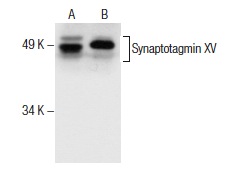
Western blot analysis of Synaptotagmin XV expression in rat brain (A) and human hippocampus (B) tissue extracts.| Product Name | Synaptotagmin XV Antibody (H-107) |
|---|---|
| Antibody Type | Primary Antibodies |
| Antigen Alias | epitope corresponding to amino acids 191-297 mapping within an internal region of Synaptotagmin XV of human origin |
| Modification Notes | Synaptotagmin XV (SytXV), also known as Synaptotagmin-15 (SYT15) or Chr10Syt, is a 421 amino acid single-pass type III membrane protein that belongs to the synaptotagmin family and contains two C2 domains. Both C2 domains are located on the C-terminal of Synaptotagmin XV and neither one mediates calcium-dependent or -independent phospholipid binding. Acting in non-neuronal tissues, Synaptotagmin XV may be involved in the trafficking and exocytosis of secretory vesicles. Synaptotagmin XV exists as four alternatively spliced isoforms that form homodimers. The gene that encodes Synaptotagmin XV contains 15,957 bases and maps to human chromosome 10q11.1. Making up nearly 4.5% of the human genome, chromosome 10 contains over 800 genes and 135 million nucleotides. Defects in some of the genes that map to chromosome 10 are associated with Charcot-Marie Tooth disease, Jackson-Weiss syndrome, Usher syndrome, nonsyndromatic deafness, Wolman’s syndrome, Cowden syndrome, Cockayne syndrome and porphyria. |
| Clonality | Polyclonal |
|---|---|
| Isotype | IgG |
| Host Species | Rabbit |
| Tested Applications | WBIPIFELISA |
| recommended for detection of Synaptotagmin XV of human and, to a lesser extent, mouse and rat origin by WB, IP, IF and ELISA also reactive with additional species, including equine, bovine and porcine: |
|
| Species Reactivity | HumanMouseRat |
| Concentration | 1mg/ml |
| Purification | Affinity purified |
| Alternative Names | epitope corresponding to amino acids 191-297 mapping within an internal region of Synaptotagmin XV of human origin |
|---|---|
| Tissue Specificity | epitope corresponding to amino acids 191-297 mapping within an internal region of Synaptotagmin XV of human origin |
| Entrez Gene | 83849 |
|---|
Application
Western blot analysis of Synaptotagmin XV expression in rat brain (A) and human hippocampus (B) tissue extracts.| Application Notes | recommended for detection of Synaptotagmin XV of human and, to a lesser extent, mouse and rat origin by WB, IP, IF and ELISA also reactive with additional species, including equine, bovine and porcine: |
|---|
| Form | Liquid |
|---|---|
| Storage Instructions | For short-term storage, store at 4° C. For long-term storage, aliquot and store at -20ºC or below. Avoid multiple freeze-thaw cycles. |
| Storage Buffer | phosphate buffered saline , pH 7.4, 150mM NaCl, 0.02% sodium azide and 50% glycerol. |


