Application
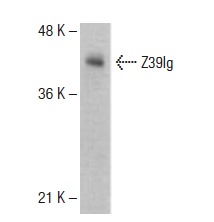
Western blot analysis of Z39Ig expression in Jurkat whole cell lysate.| Product Name | Z39Ig Antibody (Q-25) |
|---|---|
| Antibody Type | Primary Antibodies |
| Antigen Alias | recommended for detection of Z39Ig of human origin by WB, IP and ELISA |
| Modification Notes | Cell adhesion molecules (CAMs) influence cell growth, differentiation, embryogenesis, immune response and cancer metastasis by networking information from the extracellular matrix to the cell. The four major families of cell adhe-sion molecules are immunoglobulin (Ig) superfamily (calcium-independent transmembrane glycoproteins), integrins (transmembrane non-covalently linked heterodimers of a and b subunits), calcium-dependent cadherins and divalent cation-dependent selectins. Regulation of neuronal synaptic adhesion by CAMs has proven important for learning and memory. Proper embryonic morphogenic development is also heavily dependent on the regulation of cell adhesion molecules. Mutation of CAM genes has been linked to several forms of cancer, effecting tumor growth and metastasis. Z39Ig is an Ig domain cell adhesion molecule detected in all human tissue but mainly expressed in fetal human tissues, adult lungs and placenta. The Z39Ig gene is localized in the pericentromeric region of human chromosome X. |
| Clonality | Polyclonal |
|---|---|
| Isotype | IgG |
| Host Species | Rabbit |
| Tested Applications | WBIPELISA |
| WB:1:500~1:2000 IP:1:100~1:500 Notes:Optimal dilutions/concentrations should be determined by the researcher. |
|
| Species Reactivity | HumanMouseRat |
| Concentration | 1mg/ml |
| Purification | Affinity purified |
| Alternative Names | recommended for detection of Z39Ig of human origin by WB IP and ELISA |
|---|---|
| Tissue Specificity | recommended for detection of Z39Ig of human origin by WB, IP and ELISA |
| Entrez Gene | 11326 |
|---|
Application
Western blot analysis of Z39Ig expression in Jurkat whole cell lysate.| Application Notes | WB:1:500~1:2000 IP:1:100~1:500 Notes:Optimal dilutions/concentrations should be determined by the researcher. |
|---|
| Form | Liquid |
|---|---|
| Storage Instructions | For short-term storage, store at 4° C. For long-term storage, aliquot and store at -20ºC or below. Avoid multiple freeze-thaw cycles. |
| Storage Buffer | phosphate buffered saline , pH 7.4, 150mM NaCl, 0.02% sodium azide and 50% glycerol. |


