Application
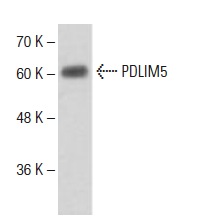
Western blot analysis of PDLIM5 expression in Hep G2 whole cell lysate.| Product Name | PDLIM5 Antibody (E-25) |
|---|---|
| Antibody Type | Primary Antibodies |
| Antigen Alias | recommended for detection of PDLIM5 of mouse, rat, human and zebrafish origin by WB, IP and ELISA; also reactive with additional species, including canine |
| Modification Notes | PDLIM5 (PDZ and LIM domain 5), also known as L9, ENH (Enigma homolog), LIM or ENH1, is a member of the Enigma family of proteins. Proteins belonging to this family contain an N-terminal PDZ (post-synaptic density-95/discs large/zone occludens-1) domain and one to three C-terminal LIM domains that typically associate with various isoforms of PKC (protein kinase C). Expressed in a wide variety of tissues, PDLIM5 contains three LIM zinc-binding domains and one PDZ domain. In the brain, PDLIM5 colocalizes with synaptic vesicles of neurotransmitters and regulates neuronal calcium signaling through an interaction with PKC 茅 and N-type Ca++ CP 氓1B (N-type calcium channel 氓1B subunit). Expression of PDLIM5 is often increased in the brain of patients with schizophrenia, major depression and bipolar disorder. This suggests that PDLIM5 may contribute to the genetic susceptibility of such conditions. |
| Clonality | Polyclonal |
|---|---|
| Isotype | IgG |
| Host Species | Rabbit |
| Tested Applications | WBIPELISA |
| WB:1:500~1:2000 IP:1:100~1:500 Notes:Optimal dilutions/concentrations should be determined by the researcher. |
|
| Species Reactivity | HumanMouseRat |
| Concentration | 1mg/ml |
| Purification | Affinity purified |
| Alternative Names | recommended for detection of PDLIM5 of mouse rat human and zebrafish origin by WB IP and ELISA also reactive with additional species including canine |
|---|---|
| Tissue Specificity | recommended for detection of PDLIM5 of mouse, rat, human and zebrafish origin by WB, IP and ELISA; also reactive with additional species, including canine |
| Entrez Gene | 10611 |
|---|
Application
Western blot analysis of PDLIM5 expression in Hep G2 whole cell lysate.| Application Notes | WB:1:500~1:2000 IP:1:100~1:500 Notes:Optimal dilutions/concentrations should be determined by the researcher. |
|---|
| Form | Liquid |
|---|---|
| Storage Instructions | For short-term storage, store at 4° C. For long-term storage, aliquot and store at -20ºC or below. Avoid multiple freeze-thaw cycles. |
| Storage Buffer | phosphate buffered saline , pH 7.4, 150mM NaCl, 0.02% sodium azide and 50% glycerol. |


