Application
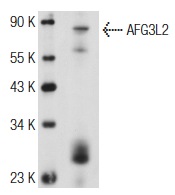
Western blot analysis of AFG3L2 expression in rat skeletal muscle tissue extract.| Product Name | AFG3L2 Antibody (L-16) |
|---|---|
| Antibody Type | Primary Antibodies |
| Antigen Alias | epitope mapping within an extracellular domain of AFG3L2 of human origin |
| Modification Notes | AFG3L2 (ATPase family gene 3-like 2), also known as Paraplegin-like protein, is a multi-pass membrane metalloprotease that contains one AAA (ATPase associated with diverse cellular activities) domain, a zinc-dependent binding motif, an RNA-binding region and an ATP/GTP binding site. Localizing to the mitochondrial membrane, AFG3L2 is ubiquitously expressed with highest expression levels in skeletal muscle and heart. AFG3L2 shares 69% similarity with the yeast Afg3 protein and 49% similarity with Paraplegin, a protein of mitochondria that is thought to be involved in signal transduction and chaperone-like activities. In mitochondria, AFG3L2 forms a complex with Paraplegin that is believed to regulate essential protein quality control. Mutations in the gene encoding either one of these proteins can result in hereditary spastic paraplegia, a degenerative spinal cord disorder that is characterized by muscle spasms, stiffness in the legs and, in some cases, incontinence. |
| Clonality | Polyclonal |
|---|---|
| Isotype | IgG |
| Host Species | Rabbit |
| Tested Applications | WBIPIFELISA |
| recommended for detection of AFG3L2 of mouse, rat and human origin by WB, IP, IF and ELISA also reactive with additional species, including equine, canine, bovine and porcine: |
|
| Species Reactivity | HumanMouseRat |
| Concentration | 1mg/ml |
| Purification | Affinity purified |
| Alternative Names | epitope mapping within an extracellular domain of AFG3L2 of human origin |
|---|---|
| Tissue Specificity | epitope mapping within an extracellular domain of AFG3L2 of human origin |
| Entrez Gene | 10939 |
|---|
Application
Western blot analysis of AFG3L2 expression in rat skeletal muscle tissue extract.| Application Notes | recommended for detection of AFG3L2 of mouse, rat and human origin by WB, IP, IF and ELISA also reactive with additional species, including equine, canine, bovine and porcine: |
|---|
| Form | Liquid |
|---|---|
| Storage Instructions | For short-term storage, store at 4° C. For long-term storage, aliquot and store at -20ºC or below. Avoid multiple freeze-thaw cycles. |
| Storage Buffer | phosphate buffered saline , pH 7.4, 150mM NaCl, 0.02% sodium azide and 50% glycerol. |


