Application
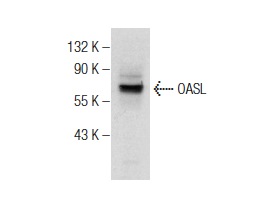
Western blot analysis of OASL expression in HL-60 whole cell lysate.| Product Name | OASL Antibody (H-200) |
|---|---|
| Antibody Type | Primary Antibodies |
| Antigen Alias | epitope corresponding to amino acids 1-200 mapping at the N-terminus of OASL of human origin |
| Modification Notes | OASL (2'-5'-oligoadenylate synthetase-like), also known as p59OASL or TRIP14 (thyroid receptor-interacting protein 14), is a 514 amino acid protein that exists as two alternatively spliced isoforms, designated p56 and p30, and contains two ubiquitin-like domains. Expressed in a variety of tissues with highest levels present in colon, stomach and testis, OASL interacts with the ligand binding domain of the thyroid receptor (TR) and is able to bind double-stranded RNA and DNA, possibly playing a role in RNA degradation and the overall inhibition of protein synthesis. The gene encoding OASL maps to human chromosome 12, which encodes over 1,100 genes and comprises approximately 4.5% of the human genome. Chromosome 12 is associated with a variety of diseases and afflictions, including hypochondrogenesis, achondrogenesis, Kniest dysplasia, Noonan syndrome and trisomy 12p, which causes facial developmental defects and seizure disorders. |
| Clonality | Polyclonal |
|---|---|
| Isotype | IgG |
| Host Species | Rabbit |
| Tested Applications | WBIPIFELISA |
| recommended for detection of OASL of human origin by WB, IP, IF and ELISA: |
|
| Species Reactivity | HumanMouseRat |
| Concentration | 1mg/ml |
| Purification | Affinity purified |
| Alternative Names | epitope corresponding to amino acids 1-200 mapping at the N-terminus of OASL of human origin |
|---|---|
| Tissue Specificity | epitope corresponding to amino acids 1-200 mapping at the N-terminus of OASL of human origin |
| Entrez Gene | 8638 |
|---|
Application
Western blot analysis of OASL expression in HL-60 whole cell lysate.| Application Notes | recommended for detection of OASL of human origin by WB, IP, IF and ELISA: |
|---|
| Form | Liquid |
|---|---|
| Storage Instructions | For short-term storage, store at 4° C. For long-term storage, aliquot and store at -20ºC or below. Avoid multiple freeze-thaw cycles. |
| Storage Buffer | phosphate buffered saline , pH 7.4, 150mM NaCl, 0.02% sodium azide and 50% glycerol. |


