Application
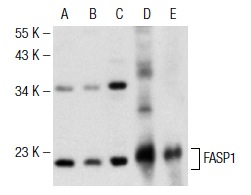
Western blot analysis of FASP1 expression in HeLa (A) and NTERA-2 (B) whole cell lysates, HeLa nuclear extract (C) and mouse brain (D) and mouse testis (E) tissue extracts.| Product Name | FASP1 Antibody (S-18) |
|---|---|
| Antibody Type | Primary Antibodies |
| Antigen Alias | epitope mapping within an internal region of FASP1 of human origin |
| Modification Notes | Mapping to chromosome 21, the FASP1 gene (FAPP1-associated protein 1) encodes a 233 amino acid protein that is homologous to the fission yeast protein Mis18. In yeast, Mis18 is localized to the centrosome and forms a complex with Mis16 to maintain the deacetylated state of histones specifically in the central core of centromeres. FASP1, also known as Protein Mis18-alpha and C21orf45, is required for the recruitment of CENP-A to centrosomes and is thereby essential for normal chromosome segregation during mitosis. With expression in testis, FASP1 exists as a homodimer, a heterodimer with MIS18B or is present in a complex containing other Mis18 family members. FASP1 has been shown to bind to pp5644 in Hela cells, where overexpression of pp5644 leads to inhibited growth and colony formation. |
| Clonality | Polyclonal |
|---|---|
| Isotype | IgG |
| Host Species | Rabbit |
| Tested Applications | WBIPIFELISA |
| recommended for detection of FASP1 of mouse and human origin by WB, IP, IF and ELISA also reactive with additional species, including bovine: |
|
| Species Reactivity | HumanMouseRat |
| Concentration | 1mg/ml |
| Purification | Affinity purified |
| Alternative Names | epitope mapping within an internal region of FASP1 of human origin |
|---|---|
| Tissue Specificity | epitope mapping within an internal region of FASP1 of human origin |
| Entrez Gene | 54069 |
|---|
Application
Western blot analysis of FASP1 expression in HeLa (A) and NTERA-2 (B) whole cell lysates, HeLa nuclear extract (C) and mouse brain (D) and mouse testis (E) tissue extracts.| Application Notes | recommended for detection of FASP1 of mouse and human origin by WB, IP, IF and ELISA also reactive with additional species, including bovine: |
|---|
| Form | Liquid |
|---|---|
| Storage Instructions | For short-term storage, store at 4° C. For long-term storage, aliquot and store at -20ºC or below. Avoid multiple freeze-thaw cycles. |
| Storage Buffer | phosphate buffered saline , pH 7.4, 150mM NaCl, 0.02% sodium azide and 50% glycerol. |


