Application
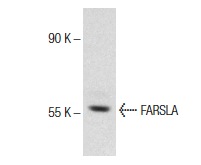
Western blot analysis of FARSLA expression in HeLa whole cell lysate.| Product Name | FARSLA Antibody (C-21) |
|---|---|
| Antibody Type | Primary Antibodies |
| Antigen Alias | recommended for detection of FARSLA of human origin by WB, IP and ELISA |
| Modification Notes | Aminoacyl-tRNA synthetases consist of a family of enzymes that catalyze the specific aminoacylation of tRNA by their cognate amino acid in the initial step of ribosome-dependent protein biosynthesis. FARSLA, also known as FRSA, CML33, FARSL or PheHA (phenylalanyl-tRNA synthetase, alpha subunit), is a member of the class-II aminoacyl-tRNA synthetase family and is highly expressed in proliferating cells of bone marrow. FARSLA is a cytoplasmic phenylalanine-tRNA synthetase that functions as a heterodimer consisting of a catalytic å-subunit and a regulatory ∫-subunit. The å-subunit is responsible for forming the amino acid binding pocket, mediating the ATP/aminoacyl adenylate binding, and interacts with the acceptor stem of the tRNA. FARSLA functions in a cell cycle-dependent and differentiation-dependent manner. |
| Clonality | Polyclonal |
|---|---|
| Isotype | IgG |
| Host Species | Rabbit |
| Tested Applications | WBIPELISA |
| WB:1:500~1:2000 IP:1:100~1:500 Notes:Optimal dilutions/concentrations should be determined by the researcher. |
|
| Species Reactivity | HumanMouseRat |
| Concentration | 1mg/ml |
| Purification | Affinity purified |
| Alternative Names | recommended for detection of FARSLA of human origin by WB IP and ELISA |
|---|---|
| Tissue Specificity | recommended for detection of FARSLA of human origin by WB, IP and ELISA |
| Entrez Gene | 2193 |
|---|
Application
Western blot analysis of FARSLA expression in HeLa whole cell lysate.| Application Notes | WB:1:500~1:2000 IP:1:100~1:500 Notes:Optimal dilutions/concentrations should be determined by the researcher. |
|---|
| Form | Liquid |
|---|---|
| Storage Instructions | For short-term storage, store at 4° C. For long-term storage, aliquot and store at -20ºC or below. Avoid multiple freeze-thaw cycles. |
| Storage Buffer | phosphate buffered saline , pH 7.4, 150mM NaCl, 0.02% sodium azide and 50% glycerol. |


