Application
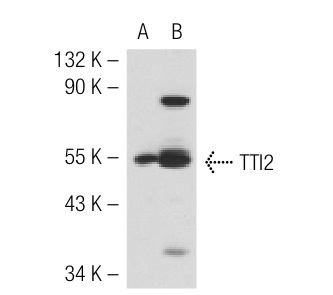
Western blot analysis of C8orf41 expression in Jurkat (A) and human PBL (B) whole cell lysates.| Product Name | TTI2 Antibody (S-12) |
|---|---|
| Antibody Type | Primary Antibodies |
| Antigen Alias | TTI2 mapping within an internal region of C8orf41 of human origin |
| Modification Notes | Made up of nearly 146 million bases, chromosome 8 encodes about 800 genes. Translocation of portions of chromosome 8 with amplifications of the c-Myc gene are found in some leukemias and lymphomas, and typically associated with a poor prognosis. Portions of chromosome 8 have been linked to schizophrenia and bipolar disorder. Trisomy 8, also known as Warkany syndrome 2, most often results in early miscarriage but is occasionally seen in a mosaic form in surviving patients who suffer to a varying degree from a number of symptoms including retarded mental and motor development, and certain facial and developmental defects. WRN is a DNA helicase encoded by chromosome 8 and shown defective in those with the early aging disorder Werner syndrome. Chromosome 8 is also associated with Pfeiffer syndrome, congenital hypothyroidism and Waardenburg syndrome. The C8orf41 gene product has been provisionally designated C8orf41 pending further characterization. |
| Clonality | Polyclonal |
|---|---|
| Isotype | IgG |
| Host Species | Rabbit |
| Tested Applications | WBIPIFELISA |
| recommended for detection of TTI2 of human origin, BC019943 of mouse origin and the corresponding rat homolog by WB, IP, IF and ELISA also reactive with additional species, including equine: |
|
| Species Reactivity | HumanMouseRat |
| Concentration | 1mg/ml |
| Purification | Affinity purified |
| Alternative Names | TTI2 mapping within an internal region of C8orf41 of human origin |
|---|---|
| Tissue Specificity | TTI2 mapping within an internal region of C8orf41 of human origin |
| Entrez Gene | 80185 |
|---|
Application
Western blot analysis of C8orf41 expression in Jurkat (A) and human PBL (B) whole cell lysates.| Application Notes | recommended for detection of TTI2 of human origin, BC019943 of mouse origin and the corresponding rat homolog by WB, IP, IF and ELISA also reactive with additional species, including equine: |
|---|
| Form | Liquid |
|---|---|
| Storage Instructions | For short-term storage, store at 4° C. For long-term storage, aliquot and store at -20ºC or below. Avoid multiple freeze-thaw cycles. |
| Storage Buffer | phosphate buffered saline , pH 7.4, 150mM NaCl, 0.02% sodium azide and 50% glycerol. |


