Application
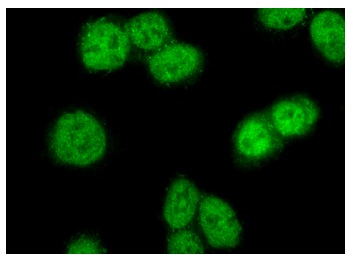
Immunofluorescence staining of formalin-fixed Hep G2 cells showing nuclear localization.Application
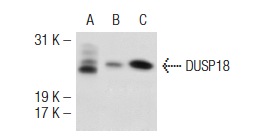
Western blot analysis of DUSP18 expression in Hep G2 (A), ES-2 (B) and HS 181.Tes (C) whole cell lysates.| Product Name | DUSP18 Antibody (N-19) |
|---|---|
| Antibody Type | Primary Antibodies |
| Antigen Alias | epitope mapping at the N-terminus of DUSP18 of human origin |
| Modification Notes | Dual specificity phosphatases (DSPs) are a subclass of the protein tyrosine phosphatase (PTP) gene superfamily, which are selective for dephosphorylating critical phosphothreonine and phosphotyrosine residues within MAP kinases. DSP gene expression is induced by a host of growth factors and/or cellular stresses, thereby negatively regulating MAP kinase superfamily members including MAPK/ERK, SAPK/JNK and p38. DUSP18 (dual specificity protein phosphatase 18), also known as low molecular weight dual specificity phosphatase 20, is a 188 amino acid enzyme that functions optimally at a pH of 6.0 and at a temperature of 55 degrees celsius. With highest expression in testis, brain, ovary and liver, DUSP18 is inhibited by iodoarectic acid and is activated by manganese ions. Along with having preferential enzymatic activity against phosphorylated tyrosine residues over threonine residues, DUSP18 also dephosphorylates p-nitrophenyl phosphate (pNPP) in vitro. |
| Clonality | Polyclonal |
|---|---|
| Isotype | IgG |
| Host Species | Rabbit |
| Tested Applications | WBIPIFELISA |
| recommended for detection of DUSP18 of human origin by WB, IP, IF and ELISA also reactive with additional species, including bovine and porcine: |
|
| Species Reactivity | HumanMouseRat |
| Concentration | 1mg/ml |
| Purification | Affinity purified |
| Alternative Names | epitope mapping at the N-terminus of DUSP18 of human origin |
|---|---|
| Tissue Specificity | epitope mapping at the N-terminus of DUSP18 of human origin |
| Entrez Gene | 150290 |
|---|
Application
Immunofluorescence staining of formalin-fixed Hep G2 cells showing nuclear localization.
Application
Western blot analysis of DUSP18 expression in Hep G2 (A), ES-2 (B) and HS 181.Tes (C) whole cell lysates.| Application Notes | recommended for detection of DUSP18 of human origin by WB, IP, IF and ELISA also reactive with additional species, including bovine and porcine: |
|---|
| Form | Liquid |
|---|---|
| Storage Instructions | For short-term storage, store at 4° C. For long-term storage, aliquot and store at -20ºC or below. Avoid multiple freeze-thaw cycles. |
| Storage Buffer | phosphate buffered saline , pH 7.4, 150mM NaCl, 0.02% sodium azide and 50% glycerol. |


