Application
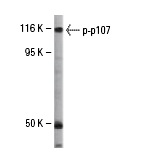
Western blot analysis of p-p107 expression in A2058 tissue extract.Application
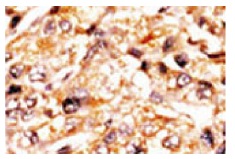
Immunoperoxidase staining of formalin fixed, paraffin-embedded human cancer tissue showing cytoplasmic staining.| Product Name | p-p107 Antibody (Ser 975) |
|---|---|
| Antibody Type | Primary Antibodies |
| Antigen Alias | recommended for detection of Ser 975 phosphorylated p107 of human origin by WB, IP, IF, IHC(P) and ELISA |
| Modification | Phosphoralated |
| Modification Notes | The human retinoblastoma gene product plays an important role in the negative regulation of cell proliferation. Functional inactivation of Rb can be mediated either through mutation or as a consequence of interaction with DNA tumor virus encoded proteins. pRb and the structurally related p107 form complexes with E2F, a transcription factor originally identified through its role in transcriptional activation of the adenovirus E2 promoter. Moreover, pRB and p107 share a high degree of structural homology in the adenovirus E1A binding domain (i.e. “pocket region”) that is believed to play a primary role in the function of these proteins. A protein designated p130 shows a high degree of identity with pRb and p107 and also possesses a pocket region. Human p107 is subject to phosphoylation on a variety of residues, including Ser 975, an event which leads to the subsequent inactivation of p107. |
| Clonality | Polyclonal |
|---|---|
| Isotype | IgG |
| Host Species | Rabbit |
| Tested Applications | WBIPIFIHCELISA |
| WB:1:500~1:2000 IP:1:100~1:500 IF:1:200~1:500 IHC:1:50~1:200 Notes:Optimal dilutions/concentrations should be determined by the researcher. |
|
| Species Reactivity | HumanMouseRat |
| Concentration | 1mg/ml |
| Purification | Affinity purified |
| Alternative Names | recommended for detection of Ser 975 phosphorylated p107 of human origin by WB IP IF IHC(P) and ELISA |
|---|---|
| Tissue Specificity | recommended for detection of Ser 975 phosphorylated p107 of human origin by WB, IP, IF, IHC(P) and ELISA |
| Entrez Gene | 5933 |
|---|
Application
Western blot analysis of p-p107 expression in A2058 tissue extract.
Application
Immunoperoxidase staining of formalin fixed, paraffin-embedded human cancer tissue showing cytoplasmic staining.| Application Notes | WB:1:500~1:2000 IP:1:100~1:500 IF:1:200~1:500 IHC:1:50~1:200 Notes:Optimal dilutions/concentrations should be determined by the researcher. |
|---|
| Form | Liquid |
|---|---|
| Storage Instructions | For short-term storage, store at 4° C. For long-term storage, aliquot and store at -20ºC or below. Avoid multiple freeze-thaw cycles. |
| Storage Buffer | phosphate buffered saline , pH 7.4, 150mM NaCl, 0.02% sodium azide and 50% glycerol. |


