Application
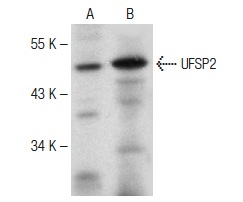
Western blot analysis of UFSP2 expression in mouse pancreas (A) and mouse heart (B) tissue extracts.| Product Name | UFSP2 Antibody (H-186) |
|---|---|
| Antibody Type | Primary Antibodies |
| Antigen Alias | epitope corresponding to amino acids 155-340 mapping within an internal region of UFSP2 of human origin |
| Modification Notes | UFM1 (ubiquitin-fold modifier 1) is a ubiquitin-like protein that is conjugated to target proteins by UBA5, an E1-like activating enzyme, and Ufc1, an E2-like conjugating enzyme. Through these interactions, UFM1 conjugates to target proteins by a covalent linkage. UFSP2 (Ufm1-specific protease 2) is a 469 amino acid thiol protease that specifically cleaves UFM1 precursor and leads to exposure of its conserved C-terminal glycine, a step required prior to conjugation to target proteins. UFSP2 is also capable of releasing UFM1 from UFM1-conjugated cellular proteins. The gene encoding UFSP2 maps to human chromosome 4, which houses nearly 6% of the human genome and has the largest gene deserts (regions of the genome with no protein encoding genes) of all of the human chromosomes. Defects in some of the genes located on chromosome 4 are associated with Huntington's disease, Ellis-van Creveld syndrome, methylmalonic acidemia and polycystic kidney disease. |
| Clonality | Polyclonal |
|---|---|
| Isotype | IgG |
| Host Species | Rabbit |
| Tested Applications | WBIPIFELISA |
| recommended for detection of UFSP2 of mouse, rat and human origin by WB, IP, IF and ELISA also reactive with additional species, including equine, canine, bovine and porcine: |
|
| Species Reactivity | HumanMouseRat |
| Concentration | 1mg/ml |
| Purification | Affinity purified |
| Alternative Names | epitope corresponding to amino acids 155-340 mapping within an internal region of UFSP2 of human origin |
|---|---|
| Tissue Specificity | epitope corresponding to amino acids 155-340 mapping within an internal region of UFSP2 of human origin |
| Entrez Gene | 55325 |
|---|
Application
Western blot analysis of UFSP2 expression in mouse pancreas (A) and mouse heart (B) tissue extracts.| Application Notes | recommended for detection of UFSP2 of mouse, rat and human origin by WB, IP, IF and ELISA also reactive with additional species, including equine, canine, bovine and porcine: |
|---|
| Form | Liquid |
|---|---|
| Storage Instructions | For short-term storage, store at 4° C. For long-term storage, aliquot and store at -20ºC or below. Avoid multiple freeze-thaw cycles. |
| Storage Buffer | phosphate buffered saline , pH 7.4, 150mM NaCl, 0.02% sodium azide and 50% glycerol. |


