Application
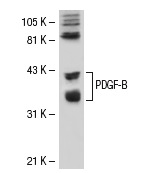
Western blot analysis of PDGF-B expression in HeLa whole cell lysate.Application
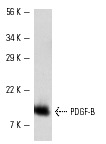
Western blot analysis of human recombinant PDGF-B.| Product Name | PDGF-B Antibody (H-55) |
|---|---|
| Antibody Type | Primary Antibodies |
| Antigen Alias | epitope corresponding to amino acids 136-190 mapping at the C-terminus of mature PDGF-B of human origin |
| Modification Notes | PDGF is a mitogen for mesenchyme- and glia-derived cells. It consists of two disulfide-bonded polypeptide chains, A and B, and occurs as three isoforms; PDGF AA, AB and BB. The three isoforms bind, with different affinities, to two receptor types, a and b, which are structurally related and endowed with protein-tyrosine kinase domains. Ligand binding induces activation of the receptor kinases by formation of receptor dimers; the A subunit of PDGF binds only to a receptors with high affinity, whereas the B subunit can bind to both a and b receptors. Evidence suggests that PDGF may function as a neurotrophic factor. Receptors for PDGF-A are expressed in oligodendrocyte progenitor cells whereas receptors for PDGF-B are expressed on neurons. These facts suggest that the different isoforms of PDGF may regulate growth and differentiation of different cell types in the developing central nervous system through paracrine and autocrine routes. |
| Clonality | Polyclonal |
|---|---|
| Isotype | IgG |
| Host Species | Rabbit |
| Tested Applications | WBIPIFELISA |
| recommended for detection of PDGF-B of mouse, rat and human origin by WB, IP, IF and ELISA also reactive with additional species, including equine, canine and porcine: |
|
| Species Reactivity | HumanMouseRat |
| Concentration | 1mg/ml |
| Purification | Affinity purified |
| Alternative Names | epitope corresponding to amino acids 136-190 mapping at the C-terminus of mature PDGF-B of human origin |
|---|---|
| Tissue Specificity | epitope corresponding to amino acids 136-190 mapping at the C-terminus of mature PDGF-B of human origin |
| Entrez Gene | 5155 |
|---|
Application
Western blot analysis of PDGF-B expression in HeLa whole cell lysate.
Application
Western blot analysis of human recombinant PDGF-B.| Application Notes | recommended for detection of PDGF-B of mouse, rat and human origin by WB, IP, IF and ELISA also reactive with additional species, including equine, canine and porcine: |
|---|
| Form | Liquid |
|---|---|
| Storage Instructions | For short-term storage, store at 4° C. For long-term storage, aliquot and store at -20ºC or below. Avoid multiple freeze-thaw cycles. |
| Storage Buffer | phosphate buffered saline , pH 7.4, 150mM NaCl, 0.02% sodium azide and 50% glycerol. |


