Application
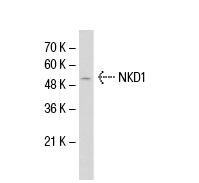
Western blot analysis of NKD1 expression in Hep G2 whole cell lysate.Application
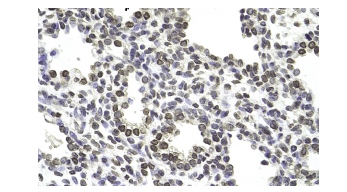
Immunoperoxidase staining of formalin fixed, paraffin-embedded human lung tissue showing nuclear and cytoplasmic staining.| Product Name | NKD1 Antibody (A-21) |
|---|---|
| Antibody Type | Primary Antibodies |
| Antigen Alias | raised against NKD1 of human origin |
| Modification Notes | The canonical Wnt signaling pathway is a complex network of proteins involving the binding of the Wnt ligand to the Frizzled family of receptors, leading to activation of the Dvl proteins and, ultimately, a change in the ∫-catenin concentration in the nucleus. NKD1 (Naked-1) is a 470 amino acid protein which functions as a negative regulator of the canonical Wnt signaling pathway. Through interactions with Dvl-1, Dvl-2, Dvl-3 and PP2A-Cå/∫, NKD1 functions as a switch that restricts classical Wnt signaling and activates a second Wnt signaling pathway that controls planar cell polarity. Localized to the cell membrane and cytoplasm, NKD1 is expressed in heart, lung, pancreas, liver, colon, kidney, ovary, placenta, skeletal muscle, prostate, small intestine, leukocyte and spleen. Elevated expression of NKD1 and Conductin mRNA has been identified in some human colon tumors that were known to have activating mutations in the canonical Wnt signaling pathway. |
| Clonality | Polyclonal |
|---|---|
| Isotype | IgG |
| Host Species | Rabbit |
| Tested Applications | WBIPIFIHCELISA |
| recommended for detection of NKD1 of human origin by WB, IP, IF, IHC(P) and ELISA: |
|
| Species Reactivity | HumanMouseRat |
| Concentration | 1mg/ml |
| Purification | Affinity purified |
| Alternative Names | raised against NKD1 of human origin |
|---|---|
| Tissue Specificity | raised against NKD1 of human origin |
| Entrez Gene | 85407 |
|---|
Application
Western blot analysis of NKD1 expression in Hep G2 whole cell lysate.
Application
Immunoperoxidase staining of formalin fixed, paraffin-embedded human lung tissue showing nuclear and cytoplasmic staining.| Application Notes | recommended for detection of NKD1 of human origin by WB, IP, IF, IHC(P) and ELISA: |
|---|
| Form | Liquid |
|---|---|
| Storage Instructions | For short-term storage, store at 4° C. For long-term storage, aliquot and store at -20ºC or below. Avoid multiple freeze-thaw cycles. |
| Storage Buffer | phosphate buffered saline , pH 7.4, 150mM NaCl, 0.02% sodium azide and 50% glycerol. |


