Application
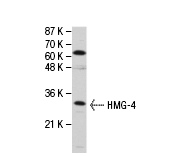
Western blot analysis of HMG-4 expression in Jurkat whole cell lysate.| Product Name | HMG-4 Antibody (I-21) |
|---|---|
| Antibody Type | Primary Antibodies |
| Antigen Alias | raised against HMG-4 of human origin |
| Modification Notes | The HMGB family, whose members include HMG-1, HMG-2, HMG-3 and HMG-4, is a highly conserved group of chromatin-associated proteins. Evidence suggests that the binding of HMG proteins to DNA induces alterations in the DNA architecture including DNA bending and unwinding of the helix. HMG proteins synergize with Oct-2, members of the NF˚B family, ATF-2 and c-Jun to activate transcription. Other studies indicate that phosphorylation of HMG proteins is required to stimulate the transcriptional activity of HMG target proteins. HMG proteins bind single-stranded DNA, but are able to induce conformational changes in double-stranded DNA. HMG-4 is a 186 amino acid protein that localizes to the nucleus. Like all other HMGB family proteins, HMG-4 contains two HMG box DNA-binding domains which can bind DNA either in a sequence-specific manner, or without sequence specificity. Additionally, the HMG box DNA-binding domains are able to preferentially bind DNA distortions, such as kinks and bulges, and, via this binding, can bend DNA. |
| Clonality | Polyclonal |
|---|---|
| Isotype | IgG |
| Host Species | Rabbit |
| Tested Applications | WBIPELISA |
| recommended for detection of HMG-4 of human origin by WB, IP and ELISA: |
|
| Species Reactivity | HumanMouseRat |
| Concentration | 1mg/ml |
| Purification | Affinity purified |
| Alternative Names | raised against HMG-4 of human origin |
|---|---|
| Tissue Specificity | raised against HMG-4 of human origin |
| Entrez Gene | 127540 |
|---|
Application
Western blot analysis of HMG-4 expression in Jurkat whole cell lysate.| Application Notes | recommended for detection of HMG-4 of human origin by WB, IP and ELISA: |
|---|
| Form | Liquid |
|---|---|
| Storage Instructions | For short-term storage, store at 4° C. For long-term storage, aliquot and store at -20ºC or below. Avoid multiple freeze-thaw cycles. |
| Storage Buffer | phosphate buffered saline , pH 7.4, 150mM NaCl, 0.02% sodium azide and 50% glycerol. |


