Application
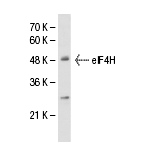
Western blot analysis of eIF4H expression in Jurkat whole cell lysate.Application
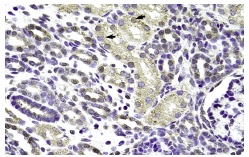
Immunoperoxidase staining of formalin fixed, paraffin-embedded human kidney tissue showing nuclear and cytoplasmic staining.| Product Name | eIF4H Antibody (L-21) |
|---|---|
| Antibody Type | Primary Antibodies |
| Antigen Alias | raised against eIF4H of human origin |
| Modification Notes | The initiation of protein synthesis in eukaryotic cells is regulated by interactions between protein initiation factors and RNA molecules. These interactions are facilitated, in part, by the eukaryotic initiation factor 4 family (eIF4) of proteins that are involved in the early initiation of protein synthesis. eIF4H (eukaryotic translation initiation factor 4H), also known as WSCR1 or WBSCR1, is a 248 amino acid protein that localizes to the perinuclear region of the cytoplasm and is expressed as two isoforms, designated short and long. While the short isoform is expressed predominately in liver and kidney, both isoforms are present in lung, pancreas, testis and spleen, where they function to stimulate RNA helicase activity. Specifically, eIF4H enhances the activity of eIF4A in the translation initiation complex, thereby promoting protein synthesis. Defects in the gene encoding eIF4H are associated with Williams-Beuren syndrome (WBS), a rare developmental disorder characterized by cardiovascular and musculo-skeletal abnormalities. |
| Clonality | Polyclonal |
|---|---|
| Isotype | IgG |
| Host Species | Rabbit |
| Tested Applications | WBIPIFIHCELISA |
| recommended for detection of eIF4H of human and canine origin by WB, IP, IF, IHC(P) and ELISA: WB:1:50~1:100 IHC:1:10~1:50 IF:1:10~1:50 ELISA:1:500~2000 |
|
| Species Reactivity | HumanMouseRat |
| Concentration | 1mg/ml |
| Purification | Affinity purified |
| Alternative Names | raised against eIF4H of human origin |
|---|---|
| Tissue Specificity | raised against eIF4H of human origin |
| Entrez Gene | 7458 |
|---|
Application
Western blot analysis of eIF4H expression in Jurkat whole cell lysate.
Application
Immunoperoxidase staining of formalin fixed, paraffin-embedded human kidney tissue showing nuclear and cytoplasmic staining.| Application Notes | recommended for detection of eIF4H of human and canine origin by WB, IP, IF, IHC(P) and ELISA: WB:1:50~1:100 IHC:1:10~1:50 IF:1:10~1:50 ELISA:1:500~2000 |
|---|
| Form | Liquid |
|---|---|
| Storage Instructions | For short-term storage, store at 4° C. For long-term storage, aliquot and store at -20ºC or below. Avoid multiple freeze-thaw cycles. |
| Storage Buffer | phosphate buffered saline , pH 7.4, 150mM NaCl, 0.02% sodium azide and 50% glycerol. |


