Application
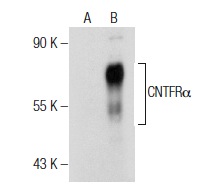
Western blot analysis of CNTFRα expression in non-transfected (A) and human CNTFRα transfected (B) whole cell lysates.| Product Name | CNTFRα Antibody (H-182) |
|---|---|
| Antibody Type | Primary Antibodies |
| Antigen Alias | epitope corresponding to amino acids 25-206 mapping near the N-terminus of CNTFRα of human origin |
| Conjugation | Agarose |
| Modification | Acetylated |
| Modification Notes | Ciliary neurotrophic factor, or CNTF, is a neuropoietic cytokine that promotes the survival and differentiation of a number of cell types including sensory, sympathetic and motor neurons. CNTF, LIF and IL-6 belong to a family of cytokines that share structural homology and signal through identical receptor components. The CNTF receptor (CNTFR) is comprised of CNTFRå, a CNTFR-specific chain, and a heterodimer of the gp130 chain common to the IL-6 and LIF receptor and the LIFRb chain. The CNTFR complex has been shown to augment DNA synthesis through the activation of transcription factors Stat1 and Stat3. CNTF has been implicated as a protein involved in the pathogenesis of amyotrophic lateral sclerosis, or ALS. However, unlike mice lacking CNTF, mice containing a homozygous null mutation in the gene encoding the CNTFRå chain die perinatally and display severe motor neuron deficits. This data suggests the existence of a second CNTFR ligand that plays a critical role in development of the neonatal nervous system. |
| Clonality | Polyclonal |
|---|---|
| Isotype | IgG |
| Host Species | Rabbit |
| Tested Applications | ELISAIFIHCIPWB |
| recommended for detection of CNTFRα of mouse, rat and human origin by WB, IP, IF and ELISA also reactive with additional species, including equine, canine, bovine and porcine: |
|
| Species Reactivity | HumanMouseRat |
| Concentration | 1mg/ml |
| Purification | Affinity purified |
| Alternative Names | epitope corresponding to amino acids 25-206 mapping near the N-terminus of CNTFRα of human origin |
|---|---|
| Tissue Specificity | epitope corresponding to amino acids 25-206 mapping near the N-terminus of CNTFRα of human origin |
| Entrez Gene | 1271 |
|---|
Application
Western blot analysis of CNTFRα expression in non-transfected (A) and human CNTFRα transfected (B) whole cell lysates.| Application Notes | recommended for detection of CNTFRα of mouse, rat and human origin by WB, IP, IF and ELISA also reactive with additional species, including equine, canine, bovine and porcine: |
|---|
| Form | Liquid |
|---|---|
| Storage Instructions | For short-term storage, store at 4° C. For long-term storage, aliquot and store at -20ºC or below. Avoid multiple freeze-thaw cycles. |
| Storage Buffer | phosphate buffered saline , pH 7.4, 150mM NaCl, 0.02% sodium azide and 50% glycerol. |


