Application
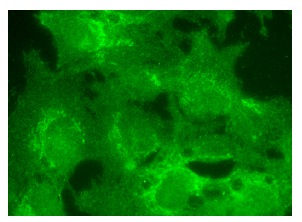
Immunofluorescence staining of formalin-fixed Hep G2 cells showing nuclear and cytoplasmic localization.| Product Name | ANKRD9 Antibody (C-13) |
|---|---|
| Antibody Type | Primary Antibodies |
| Antigen Alias | epitope mapping near the C-terminus of ANKRD9 of human origin |
| Modification Notes | Ankyrins are membrane adaptor molecules that play important roles in coupling integral membrane proteins to the spectrin-based cytoskeleton network. Mutations of ankyrin genes lead to severe genetic diseases, such as fatal cardiac arrhythmias and hereditary spherocytosis. ANKRD9 (ankyrin repeat domain 9) is a 317 amino acid protein that contains three ANK repeats. Encoded by a gene that maps to human chromosome 14q32.31, ANKRD9 is conserved in chimpanzee, dog, cow, mouse, rat and zebrafish. Hepatic mRNA levels of ANKRD9 are repressed by both thyroid hormone (T(3)) and fasting, and re-elevate by feeding after fasting. ANKRD9 mRNA levels also decrease in response to apoptosis. Localizing to cytoplasm, ANKRD9 may be involved in intracellular lipid accumulation and lipid metabolism. ANKRD9 may also function as a molecular chaperone. |
| Clonality | Polyclonal |
|---|---|
| Isotype | IgG |
| Host Species | Rabbit |
| Tested Applications | WBIFELISA |
| recommended for detection of ANKRD9 of mouse, rat and human origin by WB, IF and ELISA non cross-reactive with other ANKRD family members: |
|
| Species Reactivity | HumanMouseRat |
| Concentration | 1mg/ml |
| Purification | Affinity purified |
| Alternative Names | epitope mapping near the C-terminus of ANKRD9 of human origin |
|---|---|
| Tissue Specificity | epitope mapping near the C-terminus of ANKRD9 of human origin |
| Entrez Gene | 122416 |
|---|
Application
Immunofluorescence staining of formalin-fixed Hep G2 cells showing nuclear and cytoplasmic localization.| Application Notes | recommended for detection of ANKRD9 of mouse, rat and human origin by WB, IF and ELISA non cross-reactive with other ANKRD family members: |
|---|
| Form | Liquid |
|---|---|
| Storage Instructions | For short-term storage, store at 4° C. For long-term storage, aliquot and store at -20ºC or below. Avoid multiple freeze-thaw cycles. |
| Storage Buffer | phosphate buffered saline , pH 7.4, 150mM NaCl, 0.02% sodium azide and 50% glycerol. |


