Application
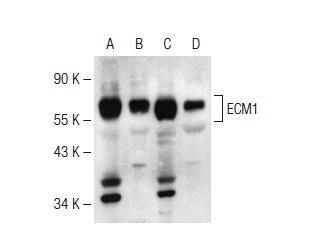
Western blot analysis of ECM1 expression in mouse kidney (A), mouse pancreas (B), rat kidney (C) and rat pancreas (D) tissue extracts.| Product Name | ECM1 Antibody (H-300) |
|---|---|
| Antibody Type | Primary Antibodies |
| Antigen Alias | epitope corresponding to amino acids 161-460 mapping within an internal region of ECM1 of human origin |
| Modification Notes | ECM1 (extracellular matrix protein 1), also known as secretory component p85, is a secreted glycoprotein that is essential for the proper structure and function of the skin. It is widely expressed and localizes to the extracellular matrix. ECM1 binds to a variety of extracellular matrix components, including Perlecan, Fibulin and matrix metalloproteinase-9 (MMP-9), and participates in the structural organization of the dermis. In addition, ECM1 enhances the association of Collagen Type IV with Laminin 332 suggesting that it is a key player in interstitial dermis and the dermal-epidermal junction. Mutations in the gene encoding ECM1 result in the autosomal recessive disorder lipoid proteinosis (LiP). LiP is characterized by hyalinization of the dermis and reduplication of the basement membrane of the skin. LiP patients exhibit thickening of the skin and mucosae. Four splice variants (known as ECM1a-ECM1d) exist for ECM1. |
| Clonality | Polyclonal |
|---|---|
| Isotype | IgG |
| Host Species | Rabbit |
| Tested Applications | WBIPIFELISA |
| recommended for detection of ECM1 of mouse, rat and human origin by WB, IP, IF and ELISA also reactive with additional species, including canine: |
|
| Species Reactivity | HumanMouseRat |
| Concentration | 1mg/ml |
| Purification | Affinity purified |
| Alternative Names | epitope corresponding to amino acids 161-460 mapping within an internal region of ECM1 of human origin |
|---|---|
| Tissue Specificity | epitope corresponding to amino acids 161-460 mapping within an internal region of ECM1 of human origin |
Application
Western blot analysis of ECM1 expression in mouse kidney (A), mouse pancreas (B), rat kidney (C) and rat pancreas (D) tissue extracts.| Application Notes | recommended for detection of ECM1 of mouse, rat and human origin by WB, IP, IF and ELISA also reactive with additional species, including canine: |
|---|
| Form | Liquid |
|---|---|
| Storage Instructions | For short-term storage, store at 4° C. For long-term storage, aliquot and store at -20ºC or below. Avoid multiple freeze-thaw cycles. |
| Storage Buffer | phosphate buffered saline , pH 7.4, 150mM NaCl, 0.02% sodium azide and 50% glycerol. |


