Application
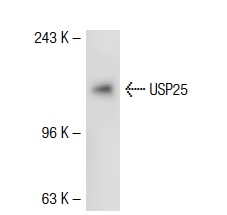
Western blot analysis of USP25 expression in mouse brain tissue extract.| Product Name | USP25 Antibody (C-17) |
|---|---|
| Antibody Type | Primary Antibodies |
| Antigen Alias | epitope mapping near the C-terminus of USP25 of human origin |
| Modification Notes | The ubiquitin (Ub) pathway involves three sequential enzymatic steps that facilitate the conjugation of Ub and Ub-like molecules to specific protein substrates. Through the use of a wide range of enzymes that can add or remove ubiquitin, the Ub pathway controls many intracellular processes such as signal transduction, transcriptional activation and cell cycle progression. USP25 (ubiquitin specific peptidase 25), also known as USP21, is a 1087 amino acid member of the peptidase C19 family. Expressed at high amounts in pancreas, kidney, skeletal muscle, testis, liver, heart, brain and lung, USP25 associates with the 26S proteasome and functions as a deubiquitinating enzyme in the Ub proteolytic pathway. Due to alternative splicing events, USP25 is expressed as two short, ubiquitously expressed isoforms and one long, muscle-specific isoform. The long isoform of USP25 is upregulated in myogenesis and is implicated in the pathogenesis of severe myopathies. |
| Clonality | Polyclonal |
|---|---|
| Isotype | IgG |
| Host Species | Rabbit |
| Tested Applications | WBIPIFELISA |
| recommended for detection of USP25 of mouse, rat and human origin by WB, IP, IF and ELISA also reactive with additional species, including equine, canine, bovine, porcine and avian: |
|
| Species Reactivity | HumanMouseRat |
| Concentration | 1mg/ml |
| Purification | Affinity purified |
| Alternative Names | epitope mapping near the C-terminus of USP25 of human origin |
|---|---|
| Tissue Specificity | epitope mapping near the C-terminus of USP25 of human origin |
| Entrez Gene | 29761 |
|---|
Application
Western blot analysis of USP25 expression in mouse brain tissue extract.| Application Notes | recommended for detection of USP25 of mouse, rat and human origin by WB, IP, IF and ELISA also reactive with additional species, including equine, canine, bovine, porcine and avian: |
|---|
| Form | Liquid |
|---|---|
| Storage Instructions | For short-term storage, store at 4° C. For long-term storage, aliquot and store at -20ºC or below. Avoid multiple freeze-thaw cycles. |
| Storage Buffer | phosphate buffered saline , pH 7.4, 150mM NaCl, 0.02% sodium azide and 50% glycerol. |


