Application
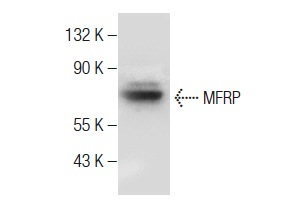
Western blot analysis of MFRP expression in TT whole cell lysate.Application
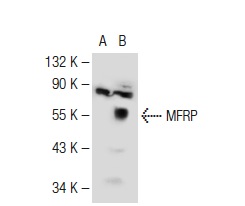
Western blot analysis of MFRP expression in non-transfected: (A) and mouse MFRP transfected: (B) 293 whole cell lysates.| Product Name | MFRP Antibody (H-194) |
|---|---|
| Antibody Type | Primary Antibodies |
| Antigen Alias | epitope corresponding to amino acids 386-579 mapping within a C-terminal extracellular domain of MFRP of human origin |
| Modification Notes | MFRP (membrane frizzled-related protein) is a single pass type II membrane protein with two cubilin (CUB) domians, two LDL-receptor class A domains, a cysteine-rich domain (CRD) and seven N-glycosylation sites. The C-terminal CRD is related to the Wnt-binding domain of the frizzled family of transmembrane proteins suggesting that MFRP may act as a Wnt receptor. MFRP is predominantly expressed in retinal pigment epithelial cells, colocalizing to the plasma membrane with CTRP5. MFRP interacts with CTRP5 via its CUB domain and may play a role in the development of the eye. Functional MFRP is necessary for photoreceptor maintenance and appears to regulate the axial length of the eye. Mutations in the gene encoding MFRP can affect various structures in the eye and may result in nanophthalmos 2 (NNO2), an eye disorder characterized by extreme hyperopia. |
| Clonality | Polyclonal |
|---|---|
| Isotype | IgG |
| Host Species | Rabbit |
| Tested Applications | WBIPIFELISA |
| recommended for detection of MFRP of human and, to a lesser extent, mouse and rat origin by WB, IP, IF and ELISA also reactive with additional species, including equine, canine, bovine and porcine: |
|
| Species Reactivity | HumanMouseRat |
| Concentration | 1mg/ml |
| Purification | Affinity purified |
| Alternative Names | epitope corresponding to amino acids 386-579 mapping within a C-terminal extracellular domain of MFRP of human origin |
|---|---|
| Tissue Specificity | epitope corresponding to amino acids 386-579 mapping within a C-terminal extracellular domain of MFRP of human origin |
| Entrez Gene | 83552 |
|---|
Application
Western blot analysis of MFRP expression in TT whole cell lysate.
Application
Western blot analysis of MFRP expression in non-transfected: (A) and mouse MFRP transfected: (B) 293 whole cell lysates.| Application Notes | recommended for detection of MFRP of human and, to a lesser extent, mouse and rat origin by WB, IP, IF and ELISA also reactive with additional species, including equine, canine, bovine and porcine: |
|---|
| Form | Liquid |
|---|---|
| Storage Instructions | For short-term storage, store at 4° C. For long-term storage, aliquot and store at -20ºC or below. Avoid multiple freeze-thaw cycles. |
| Storage Buffer | phosphate buffered saline , pH 7.4, 150mM NaCl, 0.02% sodium azide and 50% glycerol. |


