Application
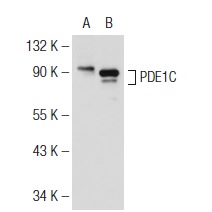
Western blot analysis of PDE1C expression in non-transfected: (A) and human PDE1C transfected: (B) 293 whole cell lysates.| Product Name | PDE1C Antibody (H-262) |
|---|---|
| Antibody Type | Primary Antibodies |
| Antigen Alias | epitope corresponding to amino acids 448-709 mapping at the C-terminus of PDE1C of human origin |
| Modification Notes | Phosphodiesterases (PDEs, also designated cyclic nucleotide phosphodiesterase) are important for the downregulation of intracellular levels of the second messengers cyclic adenosine monophosphate (cAMP) and cyclic guanosine monophosphate (cGMP). The PDE1 family are calmodulin-dependent (CaM-PDE) proteins that undergo stimulation through a calcium-calmodulin complex and function to hydrolyze cAMP to 5'AMP and cGMP to 5'GMP. PDE1C (phosphodiesterase 1C), also known as HCAM3, is a widely expressed protein that has a high affinity for both cAMP and cGMP. Two isoforms, designated PDE1C1 and PDE1C2, exist due to alternative splicing at the C-terminus. While both isoforms are expressed in low levels throughout the body, PDE1C2 is expressed predominately in the brain and heart, while PDE1C1 is expressed predominately in the brain, heart and lung. |
| Clonality | Polyclonal |
|---|---|
| Isotype | IgG |
| Host Species | Rabbit |
| Tested Applications | WBIPIFELISA |
| recommended for detection of PDE1C of mouse, rat and human origin by WB, IP, IF and ELISA also reactive with additional species, including equine and canine: |
|
| Species Reactivity | HumanMouseRat |
| Concentration | 1mg/ml |
| Purification | Affinity purified |
| Alternative Names | epitope corresponding to amino acids 448-709 mapping at the C-terminus of PDE1C of human origin |
|---|---|
| Tissue Specificity | epitope corresponding to amino acids 448-709 mapping at the C-terminus of PDE1C of human origin |
| Entrez Gene | 5137 |
|---|
Application
Western blot analysis of PDE1C expression in non-transfected: (A) and human PDE1C transfected: (B) 293 whole cell lysates.| Application Notes | recommended for detection of PDE1C of mouse, rat and human origin by WB, IP, IF and ELISA also reactive with additional species, including equine and canine: |
|---|
| Form | Liquid |
|---|---|
| Storage Instructions | For short-term storage, store at 4° C. For long-term storage, aliquot and store at -20ºC or below. Avoid multiple freeze-thaw cycles. |
| Storage Buffer | phosphate buffered saline , pH 7.4, 150mM NaCl, 0.02% sodium azide and 50% glycerol. |


