Application
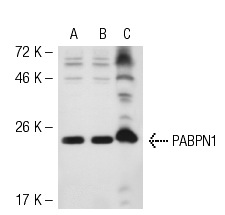
Western blot analysis of PABPN1 expression in non-transfected 293T: (A), mouse PABPN1 transfected 293T: (B) and THP-1 (C) whole cell lysates.| Product Name | PABPN1 Antibody (H-46) |
|---|---|
| Antibody Type | Primary Antibodies |
| Antigen Alias | epitope corresponding to amino acids 261-306 mapping at the C-terminus of PABPN1 of human origin |
| Modification Notes | Oculopharyngeal muscular dystrophy (OPMD), an autosomal dominant late-onset progressive disease, generally presents in patients 50-70 years of age with dysphagia, ptosis and proximal limb weakness. OPMD is caused by the abnormal expansion of a (GCG)n trinucleotide repeat in the coding region of the polyadenylate binding protein nuclear 1 (PABPN1, also designated PABP2) gene. In the wildtype form of PABPN1, (GCG)6 codes for the first six alanines in a homopolymeric stretch of ten alanines. In most individuals with OPMD, this (GCG)6 repeat is expanded to (GCG)8-13, leading to a stretch of 12-17 alanines in mutant PABPN1. Mutated PABPN1 forms aggregates consisting of tubular filaments within the nuclei of skeletal muscle fibers. The PABPN1 protein contains two RNA binding domains, a ribonucleoprotein-type RNA binding domain (RNP domain) and an arginine-rich C-terminal domain, which promotes self-association of PABPN1 and cooperative binding to RNA. |
| Clonality | Polyclonal |
|---|---|
| Isotype | IgG |
| Host Species | Rabbit |
| Tested Applications | WBIPIFELISA |
| recommended for detection of PABPN1 of mouse, rat and human origin by WB, IP, IF and ELISA also reactive with additional species, including equine, canine, bovine and porcine: |
|
| Species Reactivity | HumanMouseRat |
| Concentration | 1mg/ml |
| Purification | Affinity purified |
| Alternative Names | epitope corresponding to amino acids 261-306 mapping at the C-terminus of PABPN1 of human origin |
|---|---|
| Tissue Specificity | epitope corresponding to amino acids 261-306 mapping at the C-terminus of PABPN1 of human origin |
| Entrez Gene | 8106 |
|---|
Application
Western blot analysis of PABPN1 expression in non-transfected 293T: (A), mouse PABPN1 transfected 293T: (B) and THP-1 (C) whole cell lysates.| Application Notes | recommended for detection of PABPN1 of mouse, rat and human origin by WB, IP, IF and ELISA also reactive with additional species, including equine, canine, bovine and porcine: |
|---|
| Form | Liquid |
|---|---|
| Storage Instructions | For short-term storage, store at 4° C. For long-term storage, aliquot and store at -20ºC or below. Avoid multiple freeze-thaw cycles. |
| Storage Buffer | phosphate buffered saline , pH 7.4, 150mM NaCl, 0.02% sodium azide and 50% glycerol. |


