Application
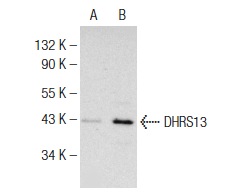
Western blot analysis of DHRS13 expression in non-transfected: (A) and human DHRS13 transfected: (B) 293T whole cell lysates.Application
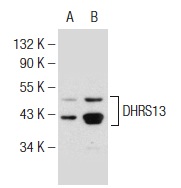
Western blot analysis of DHRS13 expression in Daudi (A) and MOLT-4 (B) whole cell lysates.| Product Name | DHRS13 Antibody (D-12) |
|---|---|
| Antibody Type | Primary Antibodies |
| Antigen Alias | epitope mapping within an internal region of DHRS13 of human origin |
| Modification Notes | DHRS13 (dehydrogenase/reductase SDR family member 13), also known as UNQ419/PRO853, is a 377 amino acid secreted protein belonging to the short-chain dehydrogenases/reductases (SDR) family. DHRS13 is presumed to function as an oxidoreductase and is phosphorylated, potentially by ATM or ATR, upon DNA damage. DHRS13 exists as two isoforms produced by alternative splicing events. The gene encoding DHRS13 maps to human chromosome 17, which comprises over 2.5% of the human genome and encodes over 1,200 genes. Neurofibromatosis, dysregulated Schwann cell growth, Alexander disease, Birt-Hogg-Dube syndrome and Canavan disease are associated with chromosome 17. |
| Clonality | Polyclonal |
|---|---|
| Isotype | IgG |
| Host Species | Rabbit |
| Tested Applications | WBIPIFELISA |
| recommended for detection of DHRS13 isoforms 1 and 2 of mouse, rat and human origin by WB, IP, IF and ELISA non cross-reactive with other DHRS family members also reactive with additional species, including canine and bovine: |
|
| Species Reactivity | HumanMouseRat |
| Concentration | 1mg/ml |
| Purification | Affinity purified |
| Alternative Names | epitope mapping within an internal region of DHRS13 of human origin |
|---|---|
| Tissue Specificity | epitope mapping within an internal region of DHRS13 of human origin |
| Entrez Gene | 147015 |
|---|
Application
Western blot analysis of DHRS13 expression in non-transfected: (A) and human DHRS13 transfected: (B) 293T whole cell lysates.
Application
Western blot analysis of DHRS13 expression in Daudi (A) and MOLT-4 (B) whole cell lysates.| Application Notes | recommended for detection of DHRS13 isoforms 1 and 2 of mouse, rat and human origin by WB, IP, IF and ELISA non cross-reactive with other DHRS family members also reactive with additional species, including canine and bovine: |
|---|
| Form | Liquid |
|---|---|
| Storage Instructions | For short-term storage, store at 4° C. For long-term storage, aliquot and store at -20ºC or below. Avoid multiple freeze-thaw cycles. |
| Storage Buffer | phosphate buffered saline , pH 7.4, 150mM NaCl, 0.02% sodium azide and 50% glycerol. |


