Application
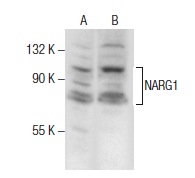
Western blot analysis of NARG1 expression in THP-1 (A) and K-562 (B) whole cell lysates.| Product Name | NARG1 Antibody (H-46) |
|---|---|
| Antibody Type | Primary Antibodies |
| Antigen Alias | epitope corresponding to amino acids 325-370 mapping within an internal region of NARG1 of human origin |
| Modification Notes | NARG1 (NMDA (N-methyl-d-aspartate) receptor-regulated gene 1), also known as NATH (N-terminal acetyltransferase), TBDN100 (tubedown-1) or Ga19 (Gastric cancer antigen Ga19), is a cytoplasmic protein that contains eight TPR repeats. NARG1 is expressed at high levels in dividing tissues such as bone marrow, testis and embryonal brain and it is overexpressed in papillary thyroid carcinomas. NARG1 interacts with ARD1 or ARD2 forming a complex that exhibits N-terminal (alpha) acetyltransferase activity. The complex interacts with ribosomal subunits functioning in cotranslational acetylation. During apoptosis, both NARG1 and ARD1 are cleaved by caspases which results in decreased acetyltransferase activity. Knockdown of NARG1 in HeLa cells leads to apoptosis, indicating that properly functioning NARG1 is essential for cell viability. In addition, this suggests NARG1 as a potential target in cancer therapy. |
| Clonality | Polyclonal |
|---|---|
| Isotype | IgG |
| Host Species | Rabbit |
| Tested Applications | WBIPIFELISA |
| recommended for detection of NARG1 of mouse, rat and human origin by WB, IP, IF and ELISA also reactive with additional species, including equine, canine, bovine, porcine and avian: |
|
| Species Reactivity | HumanMouseRat |
| Concentration | 1mg/ml |
| Purification | Affinity purified |
| Alternative Names | epitope corresponding to amino acids 325-370 mapping within an internal region of NARG1 of human origin |
|---|---|
| Tissue Specificity | epitope corresponding to amino acids 325-370 mapping within an internal region of NARG1 of human origin |
| Entrez Gene | 80155 |
|---|
Application
Western blot analysis of NARG1 expression in THP-1 (A) and K-562 (B) whole cell lysates.| Application Notes | recommended for detection of NARG1 of mouse, rat and human origin by WB, IP, IF and ELISA also reactive with additional species, including equine, canine, bovine, porcine and avian: |
|---|
| Form | Liquid |
|---|---|
| Storage Instructions | For short-term storage, store at 4° C. For long-term storage, aliquot and store at -20ºC or below. Avoid multiple freeze-thaw cycles. |
| Storage Buffer | phosphate buffered saline , pH 7.4, 150mM NaCl, 0.02% sodium azide and 50% glycerol. |


