Application
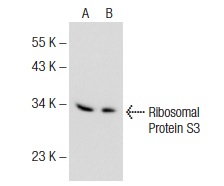
Western blot analysis of Ribosomal Protein S3 expression in HEK293 whole cell lysate (A) and HeLa nuclear extract (B).Application
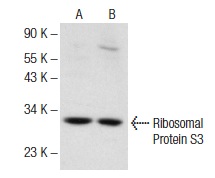
Western blot analysis of Ribosomal Protein S3 expression in HeLa (A) and Raji (B) whole cell lysates.| Product Name | Ribosomal Protein S3 Antibody (FL-243) |
|---|---|
| Antibody Type | Primary Antibodies |
| Antigen Alias | epitope corresponding to amino acids 1-243 representing full length Ribosomal Protein S3 of human origin |
| Modification Notes | Ribosomal subunits are synthesized in the nucleus, and mature 40S and 60S subunits are exported stoichiometrically into the cytoplasm. Both 40S and 60S subunits are composed of four RNA species and approximately 80 structurally distinct proteins. Mitochondrial ribosomes consist of a small 28S subunit and a large 39S subunit. Ribosomal proteins have the ability to pass through the nuclear envelope in the native state, making them the largest of the structures accommodated by the nuclear pore complexes. The nuclear export of ribosomal subunits is a unidirectional, saturable and energy-dependent process. Ribosomal Protein S3 a member of the 40S subunit and plays a role in translation and ribosome maturation. Specifically, Ribosomal Protein S3 mediates the formation of the mRNA binding site 3’ of the codon in the decoding site. In addition, Ribosomal Protein S3 is involved in DNA damage recognition as shown by its affinity for abasic sites and 7,8-dihydro-8-oxoguanine residues and its interaction with human base excision repair (BER) proteins OGG1 and Ref-1. |
| Clonality | Polyclonal |
|---|---|
| Isotype | IgG |
| Host Species | Rabbit |
| Tested Applications | WBIPIFELISA |
| recommended for detection of Ribosomal Protein S3 of mouse, rat and human origin by WB, IP, IF and ELISA also reactive with additional species, including equine, canine, bovine, porcine and avian: |
|
| Species Reactivity | HumanMouseRat |
| Concentration | 1mg/ml |
| Purification | Affinity purified |
| Alternative Names | epitope corresponding to amino acids 1-243 representing full length Ribosomal Protein S3 of human origin |
|---|---|
| Tissue Specificity | epitope corresponding to amino acids 1-243 representing full length Ribosomal Protein S3 of human origin |
| Entrez Gene | 6188 |
|---|
Application
Western blot analysis of Ribosomal Protein S3 expression in HEK293 whole cell lysate (A) and HeLa nuclear extract (B).
Application
Western blot analysis of Ribosomal Protein S3 expression in HeLa (A) and Raji (B) whole cell lysates.| Application Notes | recommended for detection of Ribosomal Protein S3 of mouse, rat and human origin by WB, IP, IF and ELISA also reactive with additional species, including equine, canine, bovine, porcine and avian: |
|---|
| Form | Liquid |
|---|---|
| Storage Instructions | For short-term storage, store at 4° C. For long-term storage, aliquot and store at -20ºC or below. Avoid multiple freeze-thaw cycles. |
| Storage Buffer | phosphate buffered saline , pH 7.4, 150mM NaCl, 0.02% sodium azide and 50% glycerol. |


