Application
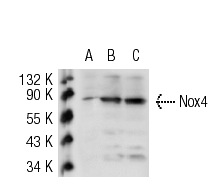
Western blot analysis of Nox4 expression in non-transfected 293T: (A), human Nox4 transfected 293T: (B) and SK-N-MC (C) whole cell lysates.Application
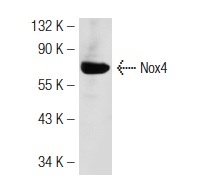
Western blot analysis of Nox4 expression in mouse placenta tissue extract.| Product Name | Nox4 Antibody (H-300) |
|---|---|
| Antibody Type | Primary Antibodies |
| Antigen Alias | epitope corresponding to amino acids 201-300 mapping within an internal region of Nox4 of human origin |
| Modification Notes | The superoxide-generating NADPH oxidase includes a membrane-bound flavocytochrome containing two subunits, gp91-phox and p22-phox, and the cytosolic proteins p47-phox and p67-phox. During activation of the NADPH oxidase, p47-phox and p67-phox migrate to the plasma membrane where they associate with the flavocytochrome, cytochrome b558, to form the active enzyme complex. The p22 and gp91-phox subunits also function as surface O2 sensors that initiate cellular signaling in response to hypoxic conditions. Nox4 (also known as Renox) is a renal gp91-phox homolog highly expressed at the site of erythropoietin production in the proximal convoluted tubule epithelial cells of the renal cortex. Nox4 is also expressed in fetal tissues, placenta, glioblastoma and vascular cells. Like gp91-phox, the enzymatic activity of Nox4 produces superoxide anions. In vascular cells, the addition of Angiotensin II increases Nox4 expression, which suggests a role for Nox4 in vascular oxidative stress response. The gene encoding human Nox4 maps to chromosome 11q14.2-q21. |
| Clonality | Polyclonal |
|---|---|
| Isotype | IgG |
| Host Species | Rabbit |
| Tested Applications | WBIPIFELISA |
| recommended for detection of Nox4 of human and, to a lesser extent, mouse and rat origin by WB, IP, IF and ELISA also reactive with additional species, including bovine: |
|
| Species Reactivity | HumanMouseRat |
| Concentration | 1mg/ml |
| Purification | Affinity purified |
| Alternative Names | epitope corresponding to amino acids 201-300 mapping within an internal region of Nox4 of human origin |
|---|---|
| Tissue Specificity | epitope corresponding to amino acids 201-300 mapping within an internal region of Nox4 of human origin |
| Entrez Gene | 50507 |
|---|
Application
Western blot analysis of Nox4 expression in non-transfected 293T: (A), human Nox4 transfected 293T: (B) and SK-N-MC (C) whole cell lysates.
Application
Western blot analysis of Nox4 expression in mouse placenta tissue extract.| Application Notes | recommended for detection of Nox4 of human and, to a lesser extent, mouse and rat origin by WB, IP, IF and ELISA also reactive with additional species, including bovine: |
|---|
| Form | Liquid |
|---|---|
| Storage Instructions | For short-term storage, store at 4° C. For long-term storage, aliquot and store at -20ºC or below. Avoid multiple freeze-thaw cycles. |
| Storage Buffer | phosphate buffered saline , pH 7.4, 150mM NaCl, 0.02% sodium azide and 50% glycerol. |


