Application
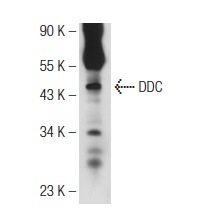
Western blot analysis of DDC expression in PC-12 whole cell lysate.| Product Name | DDC Antibody (H-45) |
|---|---|
| Antibody Type | Primary Antibodies |
| Antigen Alias | epitope corresponding to amino acids 66-110 mapping near the N-terminus of DDC of human origin |
| Modification Notes | DOPA decarboxylase (DDC), also designated aromatic-L-amino-acid decarboxylase (AADC) belongs to the group II decarboxylase family of proteins. DDC, which can form a homodimer, is an important protein in the catecholamine biosynthesis pathway. DDC acts as a catalyst in the decarboxylation of L-5-hydroxytryptophan to serotonin, L-3,4-dihydroxyphenylalanine (DOPA) to dopamine and L-tryptophan to tryptamine. Defects in the gene encoding for DDC may cause the autosomal recessive disorder AADC deficiency. AADC deficiency is an early onset inborn error in neurotransmitter metabolism which can lead to catecholamine and serotonin deficiency. This causes poor feeding, psychomotor and developmental delays, lethargy, ptosis, gastrointestinal disturbances and hypothermia. |
| Clonality | Polyclonal |
|---|---|
| Isotype | IgG |
| Host Species | Rabbit |
| Tested Applications | WBIPIFELISA |
| recommended for detection of DDC of mouse, rat and human origin by WB, IP, IF and ELISA also reactive with additional species, including equine, canine, bovine, porcine and avian: |
|
| Species Reactivity | HumanMouseRat |
| Concentration | 1mg/ml |
| Purification | Affinity purified |
| Alternative Names | epitope corresponding to amino acids 66-110 mapping near the N-terminus of DDC of human origin |
|---|---|
| Tissue Specificity | epitope corresponding to amino acids 66-110 mapping near the N-terminus of DDC of human origin |
| Entrez Gene | 13195 |
|---|
Application
Western blot analysis of DDC expression in PC-12 whole cell lysate.| Application Notes | recommended for detection of DDC of mouse, rat and human origin by WB, IP, IF and ELISA also reactive with additional species, including equine, canine, bovine, porcine and avian: |
|---|
| Form | Liquid |
|---|---|
| Storage Instructions | For short-term storage, store at 4° C. For long-term storage, aliquot and store at -20ºC or below. Avoid multiple freeze-thaw cycles. |
| Storage Buffer | phosphate buffered saline , pH 7.4, 150mM NaCl, 0.02% sodium azide and 50% glycerol. |


