Application
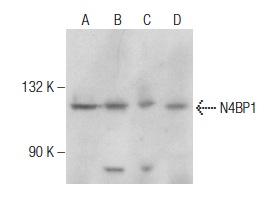
Western blot analysis of N4BP1 expression in PC-12 (A), F9 (B) and 3T3-L1 (C) whole cell lysates and rat adrenal glands tissue extract (D).| Product Name | N4BP1 Antibody (H-300) |
|---|---|
| Antibody Type | Primary Antibodies |
| Antigen Alias | epitope corresponding to amino acids 1-300 mapping at the N-terminus of N4BP1 of human origin |
| Modification Notes | N4BP1 (NEDD4 binding protein 1) is an 896 amino acid protein that belongs to the N4BP1 family. N4BP1 primarily localizes to nucleolus, however it also localizes to PML nuclear bodies when desumoylated. Detected in heart, lung, brain, liver, skeletal muscle, pancreas, kidney, spleen, testis and ovary, N4BP1 is phosphorylated upon DNA damage probably by ATM or ATR. N4BP1 interacts with Nedd4, a protein with a wide range of activities including modification of ubiquitin-protein ligase, regulation of membrane channels and potentiating hormone-dependent activation of transcription. N4BP1 inhibits the E3 ubiquitin-protein ligase ITCH, by interacting with the second WW domain of ITCH thereby competing with ITCH's substrates and impairing ubiquitination of substrates. N4BP1 has no obvious transmembrane regions, which raises the possibility that N4BP1 represents a soluble adaptor that could sequester ITCH within the cytosol. The N4BP1 gene maps to chromosome 16q12.1. |
| Clonality | Polyclonal |
|---|---|
| Isotype | IgG |
| Host Species | Rabbit |
| Tested Applications | WBIPIFELISA |
| recommended for detection of N4BP1 of mouse, rat and human origin by WB, IP, IF and ELISA also reactive with additional species, including bovine and porcine: |
|
| Species Reactivity | HumanMouseRat |
| Concentration | 1mg/ml |
| Purification | Affinity purified |
| Alternative Names | epitope corresponding to amino acids 1-300 mapping at the N-terminus of N4BP1 of human origin |
|---|---|
| Tissue Specificity | epitope corresponding to amino acids 1-300 mapping at the N-terminus of N4BP1 of human origin |
| Entrez Gene | 9683 |
|---|
Application
Western blot analysis of N4BP1 expression in PC-12 (A), F9 (B) and 3T3-L1 (C) whole cell lysates and rat adrenal glands tissue extract (D).| Application Notes | recommended for detection of N4BP1 of mouse, rat and human origin by WB, IP, IF and ELISA also reactive with additional species, including bovine and porcine: |
|---|
| Form | Liquid |
|---|---|
| Storage Instructions | For short-term storage, store at 4° C. For long-term storage, aliquot and store at -20ºC or below. Avoid multiple freeze-thaw cycles. |
| Storage Buffer | phosphate buffered saline , pH 7.4, 150mM NaCl, 0.02% sodium azide and 50% glycerol. |


