Application
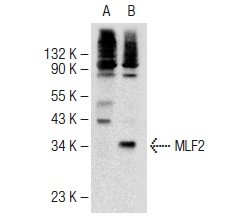
Western blot analysis of MLF2 expression in non-transfected: (A) and human MLF2 transfected: (B) 293T whole cell lysates.| Product Name | MLF2 Antibody (H-130) |
|---|---|
| Antibody Type | Primary Antibodies |
| Antigen Alias | epitope corresponding to amino acids 1-130 mapping at the N-terminus of MLF2 of human origin |
| Modification Notes | Myeloid leukemia factor (MLF) proteins typically demonstrate highest levels of expression in testis, ovary, skeletal muscle, heart, kidney and colon tissues, and lower levels of expression in spleen, thymus, and peripheral blood leukocytes. MLF proteins play a role in normal hemopoietic differentiation as well as in erythroid/myeloid lineage switching. MLF2 is a ubiquitously expressed, 248-amino acid protein which shares 40% sequence identity with myeloid leukemia factor 1 (MLF1). MLF2 maps to chromosome 12p13, a region that is often associated with translocations in acute leukemias of lymphoid and myeloid origin. However, no alterations in the structure of the MLF2 locus in patients shown to have 12p translocations have been discovered. |
| Clonality | Polyclonal |
|---|---|
| Isotype | IgG |
| Host Species | Rabbit |
| Tested Applications | WBIPIFELISA |
| recommended for detection of MLF2 (myeloid leukemia factor 2) of mouse, rat and human origin by WB, IP, IF and ELISA also reactive with additional species, including equine, canine, bovine and porcine: |
|
| Species Reactivity | HumanMouseRat |
| Concentration | 1mg/ml |
| Purification | Affinity purified |
| Alternative Names | epitope corresponding to amino acids 1-130 mapping at the N-terminus of MLF2 of human origin |
|---|---|
| Tissue Specificity | epitope corresponding to amino acids 1-130 mapping at the N-terminus of MLF2 of human origin |
| Entrez Gene | 8079 |
|---|
Application
Western blot analysis of MLF2 expression in non-transfected: (A) and human MLF2 transfected: (B) 293T whole cell lysates.| Application Notes | recommended for detection of MLF2 (myeloid leukemia factor 2) of mouse, rat and human origin by WB, IP, IF and ELISA also reactive with additional species, including equine, canine, bovine and porcine: |
|---|
| Form | Liquid |
|---|---|
| Storage Instructions | For short-term storage, store at 4° C. For long-term storage, aliquot and store at -20ºC or below. Avoid multiple freeze-thaw cycles. |
| Storage Buffer | phosphate buffered saline , pH 7.4, 150mM NaCl, 0.02% sodium azide and 50% glycerol. |


