Application
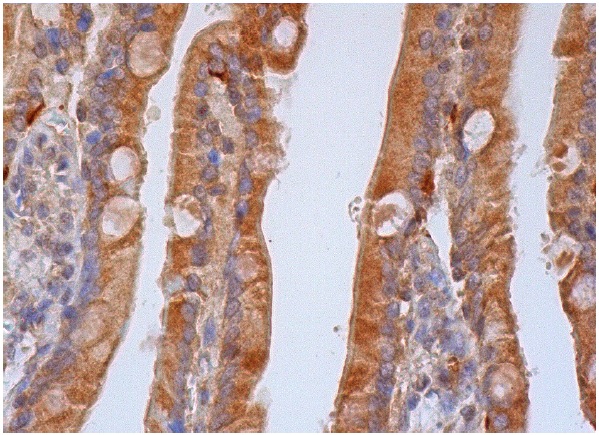
Immunoperoxidase staining of formalin fixed, paraffin-embedded human duodenum tissue showing cytoplasmic staining of glandular cells.| Product Name | LRAT Antibody (H-83) |
|---|---|
| Antibody Type | Primary Antibodies |
| Antigen Alias | epitope corresponding to amino acids 47-129 mapping within an internal region of LRAT of human origin |
| Modification Notes | Lecithin retinol acyltransferase (LRAT) is a membrane bound enzyme that catalyzes the transfer of an acyl group from the sn-1 position of lecithin to vitamin A which generates all-trans-retinyl esters (tREs) in the liver, some extrahepatic tissues, such as the lung, and retinal pigmented epithelium. LRAT can also exchange palmitoyl groups between RPE65, a tRE binding protein essential for vision, and tREs, which is important for the operation of the visual pathway. LRAT is essential for the dietary mobilization, transport, and storage of vitamin A as well as the synthesis of the visual pigment chromophore. LRAT monomers interact in membranes to form homodimers through disulfide bond formation. A loss of LRAT correlates with an early onset severe retinal dystrophy and severe retinyl ester deprivation, while a reduction in LRAT expression may be associated with invasive bladder cancer. |
| Clonality | Polyclonal |
|---|---|
| Isotype | IgG |
| Host Species | Rabbit |
| Tested Applications | WBIPIFELISA |
| recommended for detection of LRAT of mouse, rat and human origin by WB, IP, IF and ELISA also reactive with additional species, including equine, canine, bovine and porcine: |
|
| Species Reactivity | HumanMouseRat |
| Concentration | 1mg/ml |
| Purification | Affinity purified |
| Alternative Names | epitope corresponding to amino acids 47-129 mapping within an internal region of LRAT of human origin |
|---|---|
| Tissue Specificity | epitope corresponding to amino acids 47-129 mapping within an internal region of LRAT of human origin |
| Entrez Gene | 9227 |
|---|
Application
Immunoperoxidase staining of formalin fixed, paraffin-embedded human duodenum tissue showing cytoplasmic staining of glandular cells.| Application Notes | recommended for detection of LRAT of mouse, rat and human origin by WB, IP, IF and ELISA also reactive with additional species, including equine, canine, bovine and porcine: |
|---|
| Form | Liquid |
|---|---|
| Storage Instructions | For short-term storage, store at 4° C. For long-term storage, aliquot and store at -20ºC or below. Avoid multiple freeze-thaw cycles. |
| Storage Buffer | phosphate buffered saline , pH 7.4, 150mM NaCl, 0.02% sodium azide and 50% glycerol. |


