Application
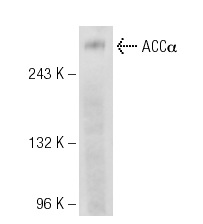
Western blot analysis of ACCα expression in DU 145 whole cell lysate.| Product Name | ACCα Antibody (H-76) |
|---|---|
| Antibody Type | Primary Antibodies |
| Antigen Alias | epitope corresponding to amino acids 1-114 representing full length ACCα of human origin |
| Modification Notes | Acetyl-CoA carboxylase (ACC) is a complex multifunctional enzyme system which catalyzes the carboxylation of acetyl-CoA to malonyl-CoA, the rate-limiting step in fatty acid synthesis. Exercise diminishes the activity of acetyl-CoA carboxylase in human muscle. ACCå (ACC1) is the rate-limiting enzyme in the biogenesis of long-chain fatty acids, and ACC∫ (ACC2) may control mitochondrial fatty acid oxidation. These two isoforms of ACC control the amount of fatty acids in the cells. The catalytic function of ACCå is regulated by phosphorylation (inactive) and dephosphorylation (active) of targeted serine residues and by allosteric transformation by citrate or palmitoyl-CoA, which serve as the enzyme’s short-term regulatory mechanism. The gene encoding ACCå maps to human chromosome 17 and encodes a form of ACC, which is the major ACC in lipogenic tissues. The catalytic core of ACC∫ is homologous to that of the ACCå, except for an additional peptide of about 150 amino acids at the N-terminus. |
| Clonality | Polyclonal |
|---|---|
| Isotype | IgG |
| Host Species | Rabbit |
| Tested Applications | WBIPIFELISA |
| recommended for detection of ACCα of mouse, rat and human origin by WB, IP, IF and ELISA also reactive with additional species, including bovine: |
|
| Species Reactivity | HumanMouseRat |
| Concentration | 1mg/ml |
| Purification | Affinity purified |
| Alternative Names | epitope corresponding to amino acids 1-114 representing full length ACC&alpha of human origin |
|---|---|
| Tissue Specificity | epitope corresponding to amino acids 1-114 representing full length ACCα of human origin |
| Entrez Gene | 31 |
|---|
Application
Western blot analysis of ACCα expression in DU 145 whole cell lysate.| Application Notes | recommended for detection of ACCα of mouse, rat and human origin by WB, IP, IF and ELISA also reactive with additional species, including bovine: |
|---|
| Form | Liquid |
|---|---|
| Storage Instructions | For short-term storage, store at 4° C. For long-term storage, aliquot and store at -20ºC or below. Avoid multiple freeze-thaw cycles. |
| Storage Buffer | phosphate buffered saline , pH 7.4, 150mM NaCl, 0.02% sodium azide and 50% glycerol. |


