Application
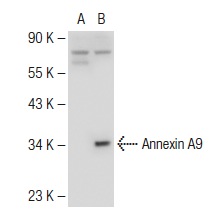
Western blot analysis of Annexin A9 expression in non-transfected: (A) and mouse Annexin A9 transfected: (B) 293T whole cell lysates.| Product Name | Annexin A9 Antibody (H-85) |
|---|---|
| Antibody Type | Primary Antibodies |
| Antigen Alias | epitope corresponding to amino acids 186-270 mapping within an internal region of Annexin A9 of human origin |
| Modification Notes | The annexin family of calcium-binding proteins contains several family members that are characterized by a conserved core domain, which binds phospholipids in a Ca2+-dependent manner, and a unique amino-terminal region, which may confer binding specificity. Annexin family members have been implicated as regulators of diverse processes, such as ion flux, endocytosis, exocytosis and cellular adhesion. Annexin A9 (ANXA9), also known as Annexin-31 (ANX31) or Pemphaxin, is a 345 amino acid protein that contains four Annexin domains and may act as a low affinity receptor for acetylcholine. It is an atypical member of the annexin family because its intracellular activity is not subject to Ca(2+) regulation as a result of sequence mutations. Annexin A9 is one of the target proteins that is recognized by autoantibodies in patients with pemphigus vulgaris, a rare autoimmune skin condition in which blisters occur in the epidermis due to loss of cell-cell adhesion. |
| Clonality | Polyclonal |
|---|---|
| Isotype | IgG |
| Host Species | Rabbit |
| Tested Applications | WBIPIFELISA |
| recommended for detection of Annexin A9 of human and, to a lesser extent, mouse and rat origin by WB, IP, IF and ELISA: |
|
| Species Reactivity | HumanMouseRat |
| Concentration | 1mg/ml |
| Purification | Affinity purified |
| Alternative Names | epitope corresponding to amino acids 186-270 mapping within an internal region of Annexin A9 of human origin |
|---|---|
| Tissue Specificity | epitope corresponding to amino acids 186-270 mapping within an internal region of Annexin A9 of human origin |
| Entrez Gene | 8416 |
|---|
Application
Western blot analysis of Annexin A9 expression in non-transfected: (A) and mouse Annexin A9 transfected: (B) 293T whole cell lysates.| Application Notes | recommended for detection of Annexin A9 of human and, to a lesser extent, mouse and rat origin by WB, IP, IF and ELISA: |
|---|
| Form | Liquid |
|---|---|
| Storage Instructions | For short-term storage, store at 4° C. For long-term storage, aliquot and store at -20ºC or below. Avoid multiple freeze-thaw cycles. |
| Storage Buffer | phosphate buffered saline , pH 7.4, 150mM NaCl, 0.02% sodium azide and 50% glycerol. |


