Application
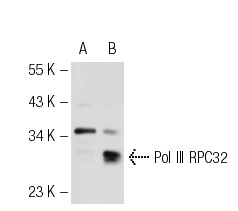
Western blot analysis of Pol III RPC32 expression in non-transfected: (A) and mouse Pol III RPC32 transfected: (B) 293T whole cell lysates.| Product Name | Pol III RPC32 Antibody (H-136) |
|---|---|
| Antibody Type | Primary Antibodies |
| Antigen Alias | epitope corresponding to amino acids 1-136 mapping at the N-terminus of Pol III RPC32 of human origin |
| Modification Notes | Eukaryotes produce three distinct classes of RNA polymerase, Pol I, II and III. Each polymerase is responsible for the synthesis of a different class of RNA. RNA polymerase I (Pol I) transcribes the rRNA (ribosomal RNA) genes for the precursor of the 28S, 18S and 5.8S molecules of the ribosome. RNA polymerase II transcribes protein-encoding genes into mRNA (messenger RNA) and snRNA (small nuclear RNA) genes into snRNAs that influence the processing of other classes of RNA. RNA polymerase III (Pol III) transcribes the 5S rRNA genes and all of the tRNA (transfer RNA) genes. |
| Clonality | Polyclonal |
|---|---|
| Isotype | IgG |
| Host Species | Rabbit |
| Tested Applications | WBIPIFELISA |
| recommended for detection of Pol III RPC32 of mouse, rat and human origin by WB, IP, IF and ELISA also reactive with additional species, including equine, canine, bovine and porcine: |
|
| Species Reactivity | HumanMouseRat |
| Concentration | 1mg/ml |
| Purification | Affinity purified |
| Alternative Names | epitope corresponding to amino acids 1-136 mapping at the N-terminus of Pol III RPC32 of human origin |
|---|---|
| Tissue Specificity | epitope corresponding to amino acids 1-136 mapping at the N-terminus of Pol III RPC32 of human origin |
| Entrez Gene | 10622 |
|---|
Application
Western blot analysis of Pol III RPC32 expression in non-transfected: (A) and mouse Pol III RPC32 transfected: (B) 293T whole cell lysates.| Application Notes | recommended for detection of Pol III RPC32 of mouse, rat and human origin by WB, IP, IF and ELISA also reactive with additional species, including equine, canine, bovine and porcine: |
|---|
| Form | Liquid |
|---|---|
| Storage Instructions | For short-term storage, store at 4° C. For long-term storage, aliquot and store at -20ºC or below. Avoid multiple freeze-thaw cycles. |
| Storage Buffer | phosphate buffered saline , pH 7.4, 150mM NaCl, 0.02% sodium azide and 50% glycerol. |


