Application
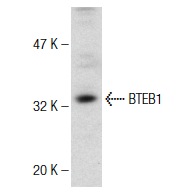
Western blot analysis of BTEB1 expression in IMR-32 nuclear extract.Application
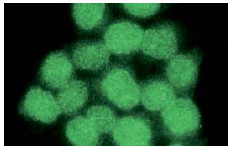
Immunofluorescence staining of methanol-fixed HeLa cells showing nuclear localization.| Product Name | BTEB1 Antibody (H-130) |
|---|---|
| Antibody Type | Primary Antibodies |
| Antigen Alias | epitope corresponding to amino acids 21-150 of BTEB1 of human origin |
| Modification Notes | Members of the C2H2 zinc finger family bind GC-rich motifs widely distributed in gene promoters, resulting in distinct activation or repression of transcriptional activities (1,2). In addition to Sp1, Sp2, Sp3, and Sp4, the basic transcription element binding proteins-1 and -2 (BTEB1 and BTEB2, respectively), belong to this family of transcriptional regulators (1,3). BTEB1 regulates transcription by binding either a single GC-box or tandemly repeated GC-boxes within the promoter (2). Predominantly localized to the nuclei of endometrial luminal and glandular epithelial cells, BTEB1 expression is both acetaldehyde and UV inducible (1,4,5). BTEB1 plays a regulatory role in pregnancy-associated endometrial epithelial gene expression and also mediates JNK-dependent alpha (I) collagen gene expression in hepatic stellate cells (5). |
| Clonality | Polyclonal |
|---|---|
| Isotype | IgG |
| Host Species | Rabbit |
| Tested Applications | WBIPIFELISA |
| recommended for detection of BTEB1 of mouse, rat and human origin by WB, IP, IF and ELISA also reactive with additional species, including equine, canine, bovine and porcine: |
|
| Species Reactivity | HumanMouseRat |
| Concentration | 1mg/ml |
| Purification | Affinity purified |
| Alternative Names | epitope corresponding to amino acids 21-150 of BTEB1 of human origin |
|---|---|
| Tissue Specificity | epitope corresponding to amino acids 21-150 of BTEB1 of human origin |
| Entrez Gene | 687 |
|---|
Application
Western blot analysis of BTEB1 expression in IMR-32 nuclear extract.
Application
Immunofluorescence staining of methanol-fixed HeLa cells showing nuclear localization.| Application Notes | recommended for detection of BTEB1 of mouse, rat and human origin by WB, IP, IF and ELISA also reactive with additional species, including equine, canine, bovine and porcine: |
|---|
| Form | Liquid |
|---|---|
| Storage Instructions | For short-term storage, store at 4° C. For long-term storage, aliquot and store at -20ºC or below. Avoid multiple freeze-thaw cycles. |
| Storage Buffer | phosphate buffered saline , pH 7.4, 150mM NaCl, 0.02% sodium azide and 50% glycerol. |


