Application
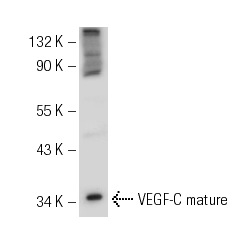
Western blot analysis of VEGF-C expression in MCF7 whole cell lysate.Application
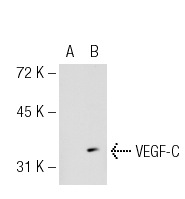
Western blot analysis of VEGF-C expression in non-transfected: (A) and human VEGF-C transfected: (B) 293T whole cell lysates.| Product Name | VEGF-C Antibody (H-48) |
|---|---|
| Antibody Type | Primary Antibodies |
| Antigen Alias | epitope corresponding to amino acids 178-225 of VEGF-C of human origin |
| Modification Notes | The onset of angiogenesis is believed to be an early event in tumorigenesis and may facilitate tumor progression and metastasis. Several growth factors with angiogenic activity have been described. These include fibroblast growth factor (FGF), platelet derived growth factor (PDGF) and vascular endothelial growth factor (VEGF). VEGF is a dimeric glycoprotein with structural homology to PDGF. Several variants of VEGF have been described that arise by alternative mRNA splicing. It has been speculated that VEGF may function as a tumor angiogenesis factor in vivo. Two additional proteins, designated VEGF-B and VEGF-C, share a significant degree of homology with VEGF. VEGF-B is abundantly expressed in heart and skeletal muscle and is frequently coexpressed with VEGF. VEGF-C binds to and specifically activates Flt-4 and Flk-1. The genes that encode VEGF-B and VEGF-C have been localized to chromosomes 11q13.1 and 4q34.3, respectively. |
| Clonality | Polyclonal |
|---|---|
| Isotype | IgG |
| Host Species | Rabbit |
| Tested Applications | WBIPIFELISA |
| recommended for detection of precursor and mature VEGF-C of mouse, rat and human origin by WB, IP, IF and ELISA also reactive with additional species, including equine, canine, bovine, porcine and avian: |
|
| Species Reactivity | HumanMouseRat |
| Concentration | 1mg/ml |
| Purification | Affinity purified |
| Alternative Names | epitope corresponding to amino acids 178-225 of VEGF-C of human origin |
|---|---|
| Tissue Specificity | epitope corresponding to amino acids 178-225 of VEGF-C of human origin |
| Entrez Gene | 7424 |
|---|
Application
Western blot analysis of VEGF-C expression in MCF7 whole cell lysate.
Application
Western blot analysis of VEGF-C expression in non-transfected: (A) and human VEGF-C transfected: (B) 293T whole cell lysates.| Application Notes | recommended for detection of precursor and mature VEGF-C of mouse, rat and human origin by WB, IP, IF and ELISA also reactive with additional species, including equine, canine, bovine, porcine and avian: |
|---|
| Form | Liquid |
|---|---|
| Storage Instructions | For short-term storage, store at 4° C. For long-term storage, aliquot and store at -20ºC or below. Avoid multiple freeze-thaw cycles. |
| Storage Buffer | phosphate buffered saline , pH 7.4, 150mM NaCl, 0.02% sodium azide and 50% glycerol. |


