Application
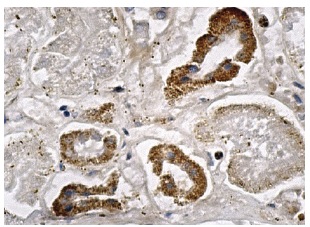
Immunoperoxidase staining of formalin fixed, paraffin-embedded human kidney tissue showing cytoplasmic staining of cells in tubules.| Product Name | Lipin-1 Antibody (H-120) |
|---|---|
| Antibody Type | Primary Antibodies |
| Antigen Alias | epitope corresponding to amino acids 261-380 mapping within an internal region of Lipin-1 of human origin |
| Modification Notes | The Lipin family of nuclear proteins contains three members: Lipin-1, Lipin-2 and Lipin-3, all of which contain a nuclear signal sequence, a highly conserved amino-terminal (NLIP) domain, and a carboxy-terminal (CLIP) domain. Lipin-1 is crucial for normal adipose tissue development and metabolism. Lipin-1 selectively activates a subset of PGC-1alpha target pathways, including fatty acid oxidation and mitochondrial oxidative phosphorylation by inducing expression of the nuclear receptor PPARalpha. Lipin-1 also inactivates the lipogenic program and suppresses circulating lipid levels. An abundance of Lipin-1 promotes fat accumulation and insulin sensitivity, whereas a deficiency in Lipin-1 may deter normal adipose tissue development, resulting in insulin resistance and lipodystrophy, a heterogeneous group of disorders characterized by loss of body fat, fatty liver, hypertriglyceridemia and insulin resistance. |
| Clonality | Polyclonal |
|---|---|
| Isotype | IgG |
| Host Species | Rabbit |
| Tested Applications | WBIPIFIHCELISA |
| recommended for detection of Lipin-1 of mouse, rat and human origin by WB, IP, IF, IHC(P) and ELISA: |
|
| Species Reactivity | HumanMouseRat |
| Concentration | 1mg/ml |
| Purification | Affinity purified |
| Alternative Names | epitope corresponding to amino acids 261-380 mapping within an internal region of Lipin-1 of human origin |
|---|---|
| Tissue Specificity | epitope corresponding to amino acids 261-380 mapping within an internal region of Lipin-1 of human origin |
| Entrez Gene | 23175 |
|---|
Application
Immunoperoxidase staining of formalin fixed, paraffin-embedded human kidney tissue showing cytoplasmic staining of cells in tubules.| Application Notes | recommended for detection of Lipin-1 of mouse, rat and human origin by WB, IP, IF, IHC(P) and ELISA: |
|---|
| Form | Liquid |
|---|---|
| Storage Instructions | For short-term storage, store at 4° C. For long-term storage, aliquot and store at -20ºC or below. Avoid multiple freeze-thaw cycles. |
| Storage Buffer | phosphate buffered saline , pH 7.4, 150mM NaCl, 0.02% sodium azide and 50% glycerol. |


