Application
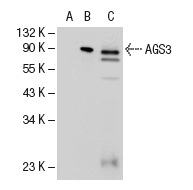
Western blot analysis of AGS3 expression in non-transfected: (A) and mouse AGS3 transfected: (B) 293T whole cell lysates and rat brain tissue extract (C).| Product Name | AGS3 Antibody (R-125) |
|---|---|
| Antibody Type | Primary Antibodies |
| Antigen Alias | epitope corresponding to amino acids 346-470 mapping within an internal region of AGS3 of rat origin |
| Modification Notes | Activators of G-protein Signaling (AGS) are non-G protein-coupled receptor (GPCR)-ligand-induced initiators of heterotrimeric G-protein signaling pathways that function either downstream of GPCR effecters or at the level of heterotrimeric G-proteins. AGS3 is a Gai-binding protein that is capable of displacing Gbg and associating with Ga-GDP, thereby stabilizing the GDP-bound conformation of Ga. AGS3 localizes to the cytoplasm and is expressed in rat brain, PC12 cells, NG108-15 cells and DDT(1)-MF2 smooth muscle cells. In rat, a 227-amino acid long form of AGS3 that contains seven TPR (tetratricopeptide repeat) domains, which target proteins to subcellular regions of neuroblasts, is more prevalent in adult rat brain, whereas the 166-amino acid short form of AGS3 is more prevalent in adult rat heart. |
| Clonality | Polyclonal |
|---|---|
| Isotype | IgG |
| Host Species | Rabbit |
| Tested Applications | WBIPIFELISA |
| recommended for detection of AGS3 of mouse, rat and human origin by WB, IP, IF and ELISA also reactive with additional species, including bovine: |
|
| Species Reactivity | HumanMouseRat |
| Concentration | 1mg/ml |
| Purification | Affinity purified |
| Alternative Names | epitope corresponding to amino acids 346-470 mapping within an internal region of AGS3 of rat origin |
|---|---|
| Tissue Specificity | epitope corresponding to amino acids 346-470 mapping within an internal region of AGS3 of rat origin |
| Entrez Gene | 26086 |
|---|
Application
Western blot analysis of AGS3 expression in non-transfected: (A) and mouse AGS3 transfected: (B) 293T whole cell lysates and rat brain tissue extract (C).| Application Notes | recommended for detection of AGS3 of mouse, rat and human origin by WB, IP, IF and ELISA also reactive with additional species, including bovine: |
|---|
| Form | Liquid |
|---|---|
| Storage Instructions | For short-term storage, store at 4° C. For long-term storage, aliquot and store at -20ºC or below. Avoid multiple freeze-thaw cycles. |
| Storage Buffer | phosphate buffered saline , pH 7.4, 150mM NaCl, 0.02% sodium azide and 50% glycerol. |


