Application
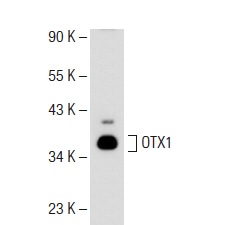
Western blot analysis of OTX1 expression in THP-1 whole cell lysate.Application
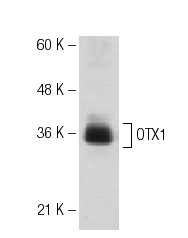
Western blot analysis of OTX1 expression in Jurkat whole cell lysate.Application
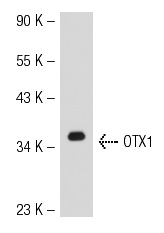
Western blot analysis of OTX1 expression in 293T whole cell lysate.| Product Name | OTX1 Antibody (Y-22) |
|---|---|
| Antibody Type | Primary Antibodies |
| Antigen Alias | recommended for detection of OTX1 of mouse, rat and human origin by WB, IP and ELISA; also reactive with additional species, including canine |
| Modification Notes | Transcription factors, OTX1 and OTX2, are two murine homologs of the Drosophila orthodenticle (OTD), show a limited amino acid sequence divergence. OTX1 and OTX2 play an important role during early and later events required for proper brain development in that they are involved in the processes of induction, specification and regionalization of the brain. OTX1 is involved in corticogenesis, sensory organ development and pituitary functions, while OTX2 is necessary earlier in development, for the correct anterior neural plate specification and organization of the primitive streak. OTX2 is also required in the early specification of the neuroectoderm, which is destined to become the fore-midbrain, and both OTX1 and OTX2 co-operate in patterning the developing brain through a dosage-dependent mechanism. A molecular mechanism depending on a precise threshold of OTX proteins is necessary for the correct positioning of the isthmic region and for anterior brain patterning. The genes which encode OTX1 and OTX2 map to human chromosomes 2p15 and 14q21-q22, respectively. |
| Clonality | Polyclonal |
|---|---|
| Isotype | IgG |
| Host Species | Rabbit |
| Tested Applications | WBIPELISA |
| WB:1:500~1:2000 IP:1:100~1:500 Notes:Optimal dilutions/concentrations should be determined by the researcher. |
|
| Species Reactivity | HumanMouseRat |
| Concentration | 1mg/ml |
| Purification | Affinity purified |
| Alternative Names | recommended for detection of OTX1 of mouse rat and human origin by WB IP and ELISA also reactive with additional species including canine |
|---|---|
| Tissue Specificity | recommended for detection of OTX1 of mouse, rat and human origin by WB, IP and ELISA; also reactive with additional species, including canine |
| Entrez Gene | 5013 |
|---|
Application
Western blot analysis of OTX1 expression in THP-1 whole cell lysate.
Application
Western blot analysis of OTX1 expression in Jurkat whole cell lysate.
Application
Western blot analysis of OTX1 expression in 293T whole cell lysate.| Application Notes | WB:1:500~1:2000 IP:1:100~1:500 Notes:Optimal dilutions/concentrations should be determined by the researcher. |
|---|
| Form | Liquid |
|---|---|
| Storage Instructions | For short-term storage, store at 4° C. For long-term storage, aliquot and store at -20ºC or below. Avoid multiple freeze-thaw cycles. |
| Storage Buffer | phosphate buffered saline , pH 7.4, 150mM NaCl, 0.02% sodium azide and 50% glycerol. |


