Application
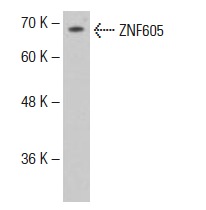
Western blot analysis of ZNF605 expression in Hep G2 whole cell lysate.| Product Name | ZNF605 Antibody (B-22) |
|---|---|
| Antibody Type | Primary Antibodies |
| Antigen Alias | recommended for detection of ZNF605 of human origin by WB, IP and ELISA |
| Modification Notes | Zinc-finger proteins contain DNA-binding domains and have a wide variety of functions, most of which encompass some form of transcriptional activation or repression. The majority of zinc-finger proteins contain a Krüppel-type DNA binding domain and a KRAB domain, which is thought to interact with KAP1, thereby recruiting histone modifying proteins. ZNF605 (zinc finger protein 605) is a 641 amino acid nuclear protein that belongs to the Krüppel C2H2-type zinc-finger protein family and may play a role in transcriptional regulation. Containing one KRAB domain and seventeen C2H2-type zinc fingers, ZNF605 is encoded by a gene that maps to human chromosome 12q24.33. Chromosome 12 encodes over 1,100 genes, comprises approximately 4.5% of the human genome and is associated with a variety of diseases and afflictions, including hypochondrogenesis, achondrogenesis, Kniest dysplasia, Noonan syndrome and trisomy 12p, which causes facial developmental defects and seizure disorders. |
| Clonality | Polyclonal |
|---|---|
| Isotype | IgG |
| Host Species | Rabbit |
| Tested Applications | WBIPELISA |
| WB:1:500~1:2000 IP:1:100~1:500 Notes:Optimal dilutions/concentrations should be determined by the researcher. |
|
| Species Reactivity | HumanMouseRat |
| Concentration | 1mg/ml |
| Purification | Affinity purified |
| Alternative Names | recommended for detection of ZNF605 of human origin by WB IP and ELISA |
|---|---|
| Tissue Specificity | recommended for detection of ZNF605 of human origin by WB, IP and ELISA |
Application
Western blot analysis of ZNF605 expression in Hep G2 whole cell lysate.| Application Notes | WB:1:500~1:2000 IP:1:100~1:500 Notes:Optimal dilutions/concentrations should be determined by the researcher. |
|---|
| Form | Liquid |
|---|---|
| Storage Instructions | For short-term storage, store at 4° C. For long-term storage, aliquot and store at -20ºC or below. Avoid multiple freeze-thaw cycles. |
| Storage Buffer | phosphate buffered saline , pH 7.4, 150mM NaCl, 0.02% sodium azide and 50% glycerol. |


